The Evidence
Reading the Life Through the Chart
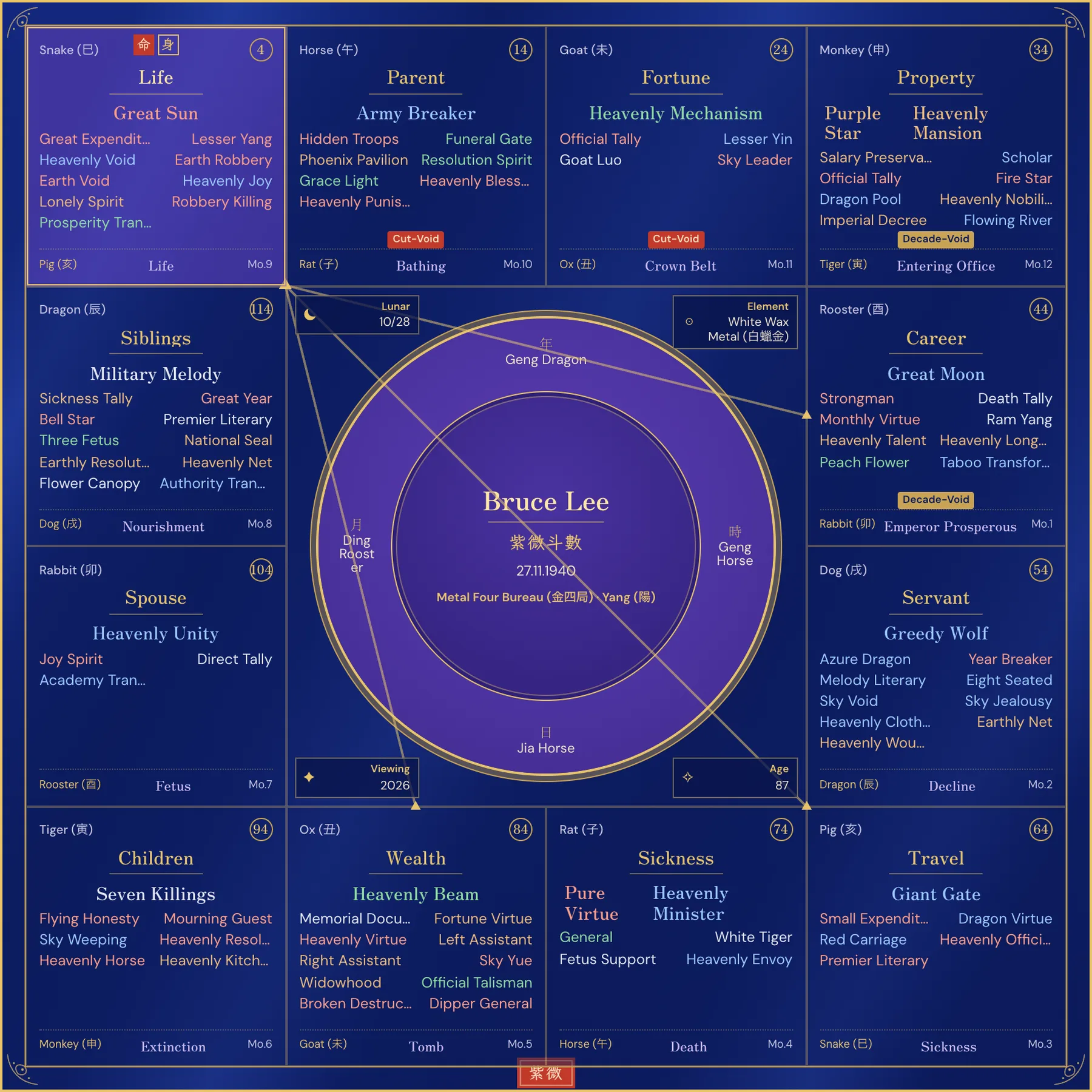
Lee's relentless drive toward perfection and global recognition stemmed from the Sun in his Life Palace
Life Palace 命宮 Palace 命宮 · Sun 太陽
The Sun 太陽 in Lee's Life Palace created a personality that could not exist in shadows—everything had to burn with maximum intensity and visibility. This solar energy manifested in his obsessive physical training regimens, where he would practice kicks thousands of times until muscle memory became art. His philosophy of 'be like water' paradoxically emerged from this solar fixity; only someone burning with such inner fire could achieve the fluidity to adapt to any container.
Lee's career trajectory followed this solar imperative toward universal recognition. When Hollywood offered him only subordinate roles like Kato in 'The Green Hornet,' his solar nature could not accept remaining in another's shadow. He returned to Hong Kong not in defeat, but to create his own cinematic sun—films like 'The Big Boss' and 'Fist of Fury' that made him the undisputed center of the action. His development of Jeet Kune Do represented the same solar principle: rather than hiding within existing martial arts traditions, he created a fighting philosophy that bore his own name and vision.
Even Lee's death at 32 reflected this solar intensity—burning too brightly, too quickly. His collapse from cerebral edema came during the peak of his powers, as 'Enter the Dragon' was poised to make him a global superstar. The Sun that drove his achievements ultimately consumed the vessel that contained it, leaving behind a legacy that continues to shine across cultures and generations.
His revolutionary approach to martial arts and cinema emerged from Breaker of Armies in his Parents Palace
Parents Palace 父母宮 Palace 父母宮 · Breaker of Armies 破軍
Breaker of Armies 破軍 in Lee's Parents Palace marked him as one destined to shatter the inherited structures of both family tradition and cultural expectation. While his father Lee Hoi-chuen achieved success within the established framework of Cantonese opera, Bruce could not follow such predetermined paths. This star's energy compelled him to break apart everything his parents' generation had built and reassemble it according to his own vision.
In martial arts, this manifested as his rejection of Wing Chun's rigid forms despite learning under the revered Ip Man. Lee famously declared that classical martial arts were like 'swimming on dry land'—beautiful in theory but useless in reality. His creation of Jeet Kune Do represented the ultimate expression of Breaker of Armies: he took centuries of Chinese fighting wisdom and demolished its formal structures, keeping only what proved effective in actual combat. This wasn't rebellion for its own sake, but the cosmic necessity of a Breaker of Armies to clear space for new growth.
In cinema, Lee's Breaker of Armies energy exploded the submissive Asian stereotypes that Hollywood had perpetuated for decades. His characters in Hong Kong films didn't bow or shuffle—they commanded the screen with fierce pride and devastating physical power. When he fought Chuck Norris in 'Way of the Dragon,' he wasn't just defeating an opponent but demolishing Western assumptions about Asian masculinity. His untimely death ensured that this revolutionary work remained unfinished, leaving future generations to continue the destruction and rebuilding he had begun.
Lee's complex relationship with violence and legacy was shaped by Seven Killings in his Children Palace
Children Palace 子女宮 Palace 子女宮 · Seven Killings 七殺
Seven Killings 七殺 in Lee's Children Palace created a profound tension between his role as a father and his identity as a warrior, ultimately manifesting in the tragic pattern that would claim both him and his son Brandon. This star traditionally governs sudden, violent change and the burden of carrying forward dangerous karma through one's lineage. Lee's relationship with violence was never simple—he sought to master it completely while hoping his children could transcend it entirely.
Lee's development of Jeet Kune Do represented an attempt to purify violence, stripping away the ego and ceremony to reveal combat's essential truth. His famous philosophy of 'be like water' emerged partly from his recognition that Seven Killings energy, uncontrolled, could destroy everything he loved. He channeled this destructive force into his films, where choreographed violence became a form of moving meditation, but the star's darker aspects remained active in his family line.
The tragedy of Brandon Lee's death in 1993—killed by an accidental gunshot on a movie set while filming 'The Crow'—fulfilled the ominous promise of Seven Killings in the Children Palace. Both father and son died at the height of their powers, both surrounded by the tools of violence that had made them famous. Yet this same star also ensured their legacy would endure through transformation—Bruce's philosophy continuing to influence martial artists worldwide, Brandon's final film becoming a testament to artistic dedication, and daughter Shannon carrying forward their vision in a new century.
His philosophical depth and teaching ability emerged from Celestial Mechanism in his Fortune Palace
Fortune Palace 福德宮 Palace 福德宮 · Celestial Mechanism 天機
Celestial Mechanism 天機 in Lee's Fortune Palace created the intellectual foundation that elevated him from mere fighter to philosopher-warrior, giving him the mental agility to synthesize Eastern and Western thought into revolutionary new forms. This star governs wisdom, strategy, and the ability to perceive underlying patterns—qualities that distinguished Lee's approach from conventional martial artists who relied purely on physical technique.
Lee's philosophical studies at the University of Washington, where he immersed himself in both Eastern and Western philosophical traditions, reflected Celestial Mechanism's influence on his spiritual development. His famous writings and interviews revealed a mind constantly working to understand the deeper principles behind physical movement and mental cultivation. His concept of 'the art of fighting without fighting' emerged from this star's wisdom—understanding that the highest victory comes through superior knowledge rather than superior force.
The teaching dimension of Lee's career also flowed from Celestial Mechanism in the Fortune Palace. His students in Seattle, Oakland, and Los Angeles didn't simply learn techniques—they absorbed a complete philosophy of self-development that integrated physical training with mental cultivation. His ability to articulate complex concepts in simple, memorable phrases ('be like water,' 'using no way as way') demonstrated this star's gift for making profound wisdom accessible. Even his films functioned as teaching tools, with each fight scene illustrating philosophical principles about adaptability, directness, and the transcendence of rigid thinking.
His magnetic screen presence and ability to attract devoted followers came from Greedy Wolf in his Friends Palace
Friends Palace 交友宮 Palace 交友宮 · Greedy Wolf 貪狼
Greedy Wolf 貪狼 in Lee's Friends Palace created the charismatic magnetism that drew people into his orbit and made him a compelling screen presence, but also generated the restless desire for more that kept him perpetually unsatisfied with his achievements. This star governs attraction, desire, and the ability to inspire others—qualities that made Lee not just a martial artist but a cultural phenomenon whose influence extended far beyond fighting.
Lee's ability to attract devoted students and disciples reflected Greedy Wolf's power to create intense personal bonds. Students like Dan Inosanto, James Coburn, and Steve McQueen didn't just learn from Lee—they became passionate advocates for his philosophy, spreading Jeet Kune Do principles throughout their own networks. His teaching sessions were known for their intensity and intimacy, with Lee able to inspire complete dedication in his followers through the force of his personality and the depth of his knowledge.
In his film career, Greedy Wolf's influence manifested as an almost hypnotic screen presence that transcended cultural boundaries. Audiences who had never seen Asian martial arts felt immediately drawn to Lee's performances, sensing something authentic and powerful that couldn't be faked or taught. His famous fight scenes worked not just as action sequences but as displays of pure charisma—the camera loved him because Greedy Wolf energy naturally attracts attention and admiration. Yet this same star also created his chronic dissatisfaction with each level of success, always hungering for greater recognition and more complete artistic control.
His complicated relationship with fame and public image was shaped by Giant Gate in his Travel Palace
Travel Palace 遷移宮 Palace 遷移宮 · Giant Gate 巨門
Giant Gate 巨門 in Lee's Travel Palace created the complex dynamic between his public persona and private reality, making him simultaneously one of the world's most recognizable figures and one of its most misunderstood. This star governs communication, reputation, and the challenges that arise when one's image becomes larger than life, perfectly capturing Lee's experience of global fame that came with both tremendous power and unexpected burdens.
Lee's international breakthrough came through his ability to communicate across cultural boundaries—his films spoke a universal language of physical excellence and moral integrity that transcended spoken words. Giant Gate's influence helped him project an image of strength and wisdom that resonated with audiences worldwide, from Hong Kong teenagers to Hollywood celebrities. His interviews and demonstrations revealed someone who could articulate complex philosophical concepts while displaying devastating physical skills, creating a public persona that was both authentic and carefully crafted.
Yet Giant Gate also brought the shadow side of fame—misrepresentation, cultural appropriation of his ideas, and the burden of serving as a symbol for entire communities. Lee's frustration with being typecast in Hollywood, his anger at seeing Kung Fu given to David Carradine, and his complex feelings about representing all of Asia in Western media reflected this star's tendency to create communication problems even as it enhances one's ability to reach large audiences. His early death at the peak of his fame ensured that Giant Gate's challenges would continue posthumously, as his image became a symbol that could be interpreted and misinterpreted by countless others who never knew the man behind the legend.