Evolutionary Revolutionary · 1809–1882

What hidden purpose guided a chronically ill, reclusive gentleman to upend the foundations of science?

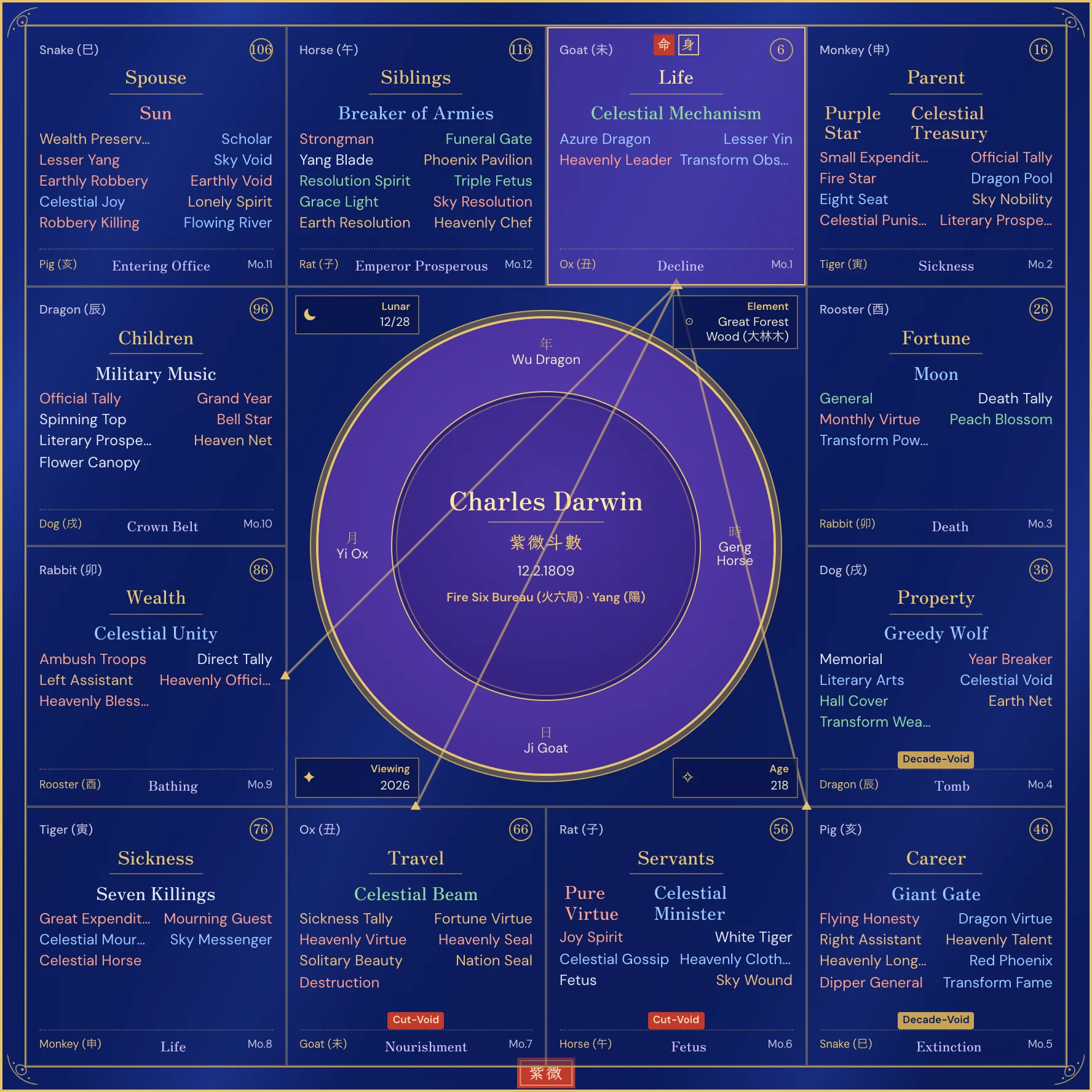
Darwin's natal chart reveals a life governed by a paradoxical alignment: a Life Palace of Celestial Mechanism, indicating hidden intellectual depth and strategic thought, supported by a Parents Palace of Purple Star and Celestial Treasury, which provided the social standing and financial independence that allowed him to work in isolation. The Health Palace of Seven Killings and the Property Palace of Greedy Wolf suggest that his body and home were arenas of constant struggle, while the Career Palace of Giant Gate reflects the tremendous obstacles he had to overcome to bring his theory to light. Darwin's revolutionary work was not achieved despite his limitations but precisely through them, as his chart maps a path of guarded intellectual discovery conducted from a protected, yet painful, domestic sanctuary.

Editorial note, last updated 2026-11-03

Published by the Purple Star Astrology Editorial Team. Biographical facts should be supported by the page references. Astrological claims are interpretations; inferred birth hours are clearly labeled and are not verified facts. This page is independent editorial content and is not affiliated with or endorsed by the person, their estate, or any rights holder. Methodology, sources, and corrections

ⓘ Birth hour inferred — Charles Darwin’s exact birth time is unrecorded. We selected the Horse 午 hour as the best fit among all twelve charts. Hour-dependent claims are interpretive. Why the birth hour matters.
Charles Darwin Purple Star Astrology chart
Born 1809-02-12·Hour: Horse 午 (11:00 AM–1:00 PM)·Life Palace: Celestial Mechanism 天機

The Chart

Fire Six Cycle | Life Palace in Goat

Charles Robert Darwin entered the world on 12 February 1809 in the genteel market town of Shrewsbury, England. He was the fifth of six children of the physician and financier Dr. Robert Waring Darwin and Susannah Wedgwood, whose family had built a fortune on pottery and porcelain. The Darwin-Wedgwood alliance connected him to the leading industrial and intellectual circles of the English Midlands. Yet the baby who grew into a gentle, shy collector of beetles seemed destined for an unremarkable life as a country clergyman or at best a gentleman naturalist. His mother died when he was eight, an early loss that deeply marked him.

As a youth, Darwin disappointed his father by failing to take to medicine at Edinburgh; he sank into a desultory pursuit of natural history, riding and shooting at the edges of the curriculum. At Cambridge he found not a vocation but a mentor, John Stevens Henslow, who secured him the most consequential opportunity of his life: to serve as naturalist aboard HMS Beagle on a five-year voyage of discovery. He returned in 1836, not knowing that he carried the seeds of a revolution.

The man who eventually published On the Origin of Species in 1859 was no comfortable academic. He was a wealthy recluse, racked by mysterious physical symptoms that spared him from the oppressive questioning of society. In his home at Down House in Kent, he conducted experiments on barnacles, pigeons, and earthworms, all while guarding a dangerous theory that would overturn humanity's understanding of its own nature. This biography uses the lens of Zi Wei Dou Shu to ask: What hidden pattern runs beneath the surface of his quiet yet extraordinary life?

Life Palace 命宮: Celestial Mechanism 天機 · Body Palace 身宮: Celestial Mechanism 天機

The Evidence

Reading the Life Through the Chart

Darwin's intellectual method—patient, secretive, and deeply strategic—is the signature of Celestial Mechanism, the star that governs his Life Palace.

Life Palace Palace 命宮 · Celestial Mechanism 天機

The Life Palace 命宮 is ruled by Celestial Mechanism 天機, a star that signifies hidden machinery, strategic calculation, and the turning of invisible wheels. Darwin's entire intellectual life bears this seal. From his boyhood, he collected objects—seals, shells, beetles—and catalogued them with a secretive intensity. His schoolmasters thought him ordinary, but he was methodically building a private store of observation. Later, after the Beagle voyage, he settled into a pattern of silent accumulation. He wrote his 'transmutation notebooks' in a private shorthand, confiding his ideas to no one outside a small circle for over twenty years. His caution was so extreme that he left instructions for his wife to publish his theory if he died. The star Celestial Mechanism is about things turning out of sight; Darwin's mind turned ceaselessly, hidden from the public until the evidence demanded disclosure. Even his health acted as a protector, providing an excuse to retreat from society and dedicate himself to the machinery of thought.

Darwin's financial and social independence, rooted in a legacy of scientific and industrial achievement, mirrors the authority of Purple Star and the abundance of Celestial Treasury.

Parents Palace Palace 父母宮 · Purple Star 紫微 · Celestial Treasury 天府

The Parents Palace 父母宮 holds two luminaries: Purple Star 紫微, the emperor star of central authority, and Celestial Treasury 天府, a storehouse of abundance. This combination perfectly accounts for the financial and intellectual inheritance Darwin received. His father's wealth—from medicine and shrewd investments—allowed him to never take a paid position; his mother's Wedgwood fortune gave him additional income upon marriage. By his late twenties, he had an independent income that freed him to spend years classifying barnacles and decades refining his theory without concern for patronage or sales. The Purple Star also points to the intellectual dynasty: his grandfather Erasmus Darwin was a famed poet-physician who had already proposed evolutionary ideas, a central figure in his world. Charles Darwin absorbed this lineage of natural philosophy, but he also rebelled against its over-confident speculation, demanding empirical proof. The combination of secure financial base (Treasury) and a sense of destined intellectual authority (Purple) gave him the confidence to challenge the establishment, even as he felt personally unworthy of glory.

Darwin's lifelong severe illness, which both confined and transformed him, corresponds to the cutting and transformative nature of Seven Killings in the Health Palace.

Health Palace Palace 疾厄宮 · Seven Killings 七殺

Seven Killings 七殺 is one of the most dreaded stars in the Zi Wei system—a harbinger of crisis, transformation, and cutting. In Darwin's Health Palace 疾厄宮, it reflects the decades of mysterious and painful illness that plagued him. Shortly after his return from the Beagle, Darwin began to suffer bouts of vomiting, nausea, headache, and exhaustion. The symptoms came and went with no clear cause, and they structured his entire adult life into a routine of short work hours, enforced rest, and isolation. Biographers have debated whether it was Chagas disease, anxiety disorder, or another condition, but the astrological point is that this illness was formative. Seven Killings cuts away the extraneous. It forced Darwin to abandon the London social scene and any thought of a conventional academic career. He became a 'patient in residence' at Down House. Yet the killing star is also a transformer: Darwin turned his suffering into a productivity that few healthy people could match. The illness gave him the one thing a man of his temperament most needed: solitude. In the hush of his sickroom, he could work unmolested.

The publication of On the Origin of Species and the subsequent controversy were a monumental challenge, fitting the obstructive and guarding nature of Giant Gate in the Career Palace.

Career Palace Palace 官祿宮 · Giant Gate 巨門

The Career Palace 官祿宮 holds Giant Gate 巨門, a star that blocks and guards. For Darwin, the entire process of bringing his theory to the world was a forced passage through a narrow and heavily defended portal. He wrote the first draft of his theory in 1844—fifteen years before publication. He kept it locked away, fearing the backlash. When Alfred Russel Wallace's letter arrived in 1858, Darwin was forced to act, but even then he approached the gate with caution, allowing Lyell and Hooker to handle the joint presentation. The publication of On the Origin of Species in 1859 was one of the most consequential acts in the history of science, but it was also a traumatic breaking open of a sealed door. The controversy that followed—the Wilberforce‑Huxley debate, the public charges of blasphemy, the painful rifts with friends—was the price of passing through Giant Gate. Yet the same star also suggests that once the gate is passed, the career becomes defined by it. Darwin spent the remaining years of his life hammering out the details, moving from Origin to The Descent of Man, each book adding beams to the edifice he had entered.

Darwin's domestic sphere at Down House was the crucible of his work and his hidden ambition, reflecting the desire and accumulation embodied in Greedy Wolf.

Property Palace Palace 田宅宮 · Greedy Wolf 貪狼

The Property Palace 田宅宮 is governed by Greedy Wolf 貪狼, a star of desire, accumulation, and sensual appetite. In Darwin's life, this star manifests in two ways. First, his home itself—Down House—became the center of his universe. He moved there in 1842, and for the next forty years it was his laboratory, sanctuary, and prison. He turned its grounds into a vast experiment: he bred pigeons, grew exotic plants, monitored earthworm activity for decades. The Greedy Wolf drove him to accumulate specimens, data, and observations with an almost compulsive hunger. Second, the star also reflects his hidden ambition. Darwin knew he was working toward a massive, revolutionary synthesis. He wanted to be remembered as the man who solved the mystery of species. He built his career like a wolf building a den, but he did it in plain sight, within the walls of his garden. And there were losses: three of his children died, including his beloved daughter Anne, whose death at ten grieved him deeply. The Greedy Wolf can also bring grief, as accumulation can be followed by loss. Yet from that domestic soil grew the big idea that changed science.
The Arc of a Life

Decade Cycles 大限

Age 6–15 · 1815–1824

Life Palace 命宮

Events: Attends Shrewsbury School; mother dies in 1817; starts beetle and shell collections; considered a mediocre student.

Reading: The Celestial Mechanism in the Life Palace accounts for his unassuming school career and his secretive passion for collecting. Already he was learning to observe and catalogue, skills that would underpin his later research. The decade is one of hidden growth.

Age 16–25 · 1825–1834

Parents Palace 父母宮

Events: Studies medicine at Edinburgh (1825); transfers to Cambridge (1828); meets Henslow and Sedgwick; graduates and is recommended for the Beagle voyage (1831); sails on HMS Beagle (1831–).

Reading: The Purple Star of authority and the Celestial Treasury of abundance provide the support he needs. His family wealth covers his education and travel. The Beagle opportunity comes through Henslow, a father figure in science. The decade establishes his independence and begins his global education.

Age 26–35 · 1835–1844

Fortune Palace 福德宮

Events: Returns from Beagle (1836); publishes Journal (1839); marries Emma Wedgwood (1839); moves to London; chronic illness appears; starts first transmutation notebook (1837).

Reading: The Moon 太陰 in the Fortune Palace indicates a reflective, yin period. Darwin withdraws from public life as his health deteriorates, but his inner work intensifies. His fortune lies in having the privacy and means to pursue radical ideas in secret. The years lay the foundation for his theory.

Age 46–55 · 1855–1864

Career Palace 官祿宮

Events: Receives Wallace's manuscript (1858); joint announcement with Wallace; publishes On the Origin of Species (1859); controversy escalates; Huxley defends Darwin at Oxford; Darwin publishes on orchids and climbing plants.

Reading: The Giant Gate 巨門 in the Career Palace describes the overwhelming difficulty of publishing. Darwin's cautious disposition is forced into action by Wallace's letter. The gate opens, but the opposition is fierce. His career is now defined by this one breakthrough; all subsequent work is its elaboration.

Age 66–75 · 1875–1884

Travel Palace 遷移宮

Events: Writes Autobiography (1876, posthumously published); publishes Insectivorous Plants (1875), The Power of Movement in Plants (1880); health declines; dies 19 April 1882; buried in Westminster Abbey.

Reading: Celestial Beam 天梁 in the Travel Palace suggests burden and support. In his final decade, Darwin becomes a revered elder, a beam upholding the new paradigm. His 'travel' is both literal—within his own home—and final, to Westminster. The beam star supports the weight of a transformed science.

The Verdict

Charles Darwin's life, as illuminated by the stars of his natal chart, was not a series of accidents but a coherent pattern: a hidden intelligence nurtured by privilege, tempered by illness, and finally unleashed through a formidable gate. The Celestial Mechanism of his Life Palace turned in the dark; the Seven Killings of his Health Palace cleared his path for labor; the Giant Gate of his Career Palace yielded only to a lifetime of preparation. He was a reluctant revolutionary, a man of privilege who used his position to shake the very foundations of privilege's ideology. The chart does not predict—it explains. In Darwin's case, it explains how a sick, quiet, wealthy naturalist became the most important biologist in history.

The capacity to change the world does not always reside in robust health, public charisma, or immediate success. It can grow in silence, in suffering, and in patient accumulation—the hidden work of a disciplined mind.

About This Reading

This reading is cast in Purple Star Astrology (Zi Wei Dou Shu 紫微斗數): a chart is computed from the birth date and hour, then read palace by palace.

The hour of Darwin's birth is not recorded in the available historical record. A Horse hour (午, 11:00–13:00) has been inferred for this chart, based on the traditional assignment of noon to the Horse. All placements dependent on the hour—including the establishment of the Life Palace, the Body Palace, and the order of the palaces—are therefore interpretive rather than documentary. The analysis follows the formal structure of Zi Wei Dou Shu and uses only the major stars listed in the computed chart for each palace. No claim is made that this is a definitive or prophetic reading; it is a retrospective interpretation using the symbolic language of the system.

  • Research packet — Compiled biography from standard sources; no conflicting hour record.
  • Browne, E. J. (1995). Charles Darwin: Voyaging.
  • Desmond, A. & Moore, J. (1991). Darwin: The Life of a Tormented Evolutionist.
  • Darwin, C. (1887). The Autobiography of Charles Darwin.

What does your chart reveal?

Calculate your free chart