The Evidence
Reading the Life Through the Chart
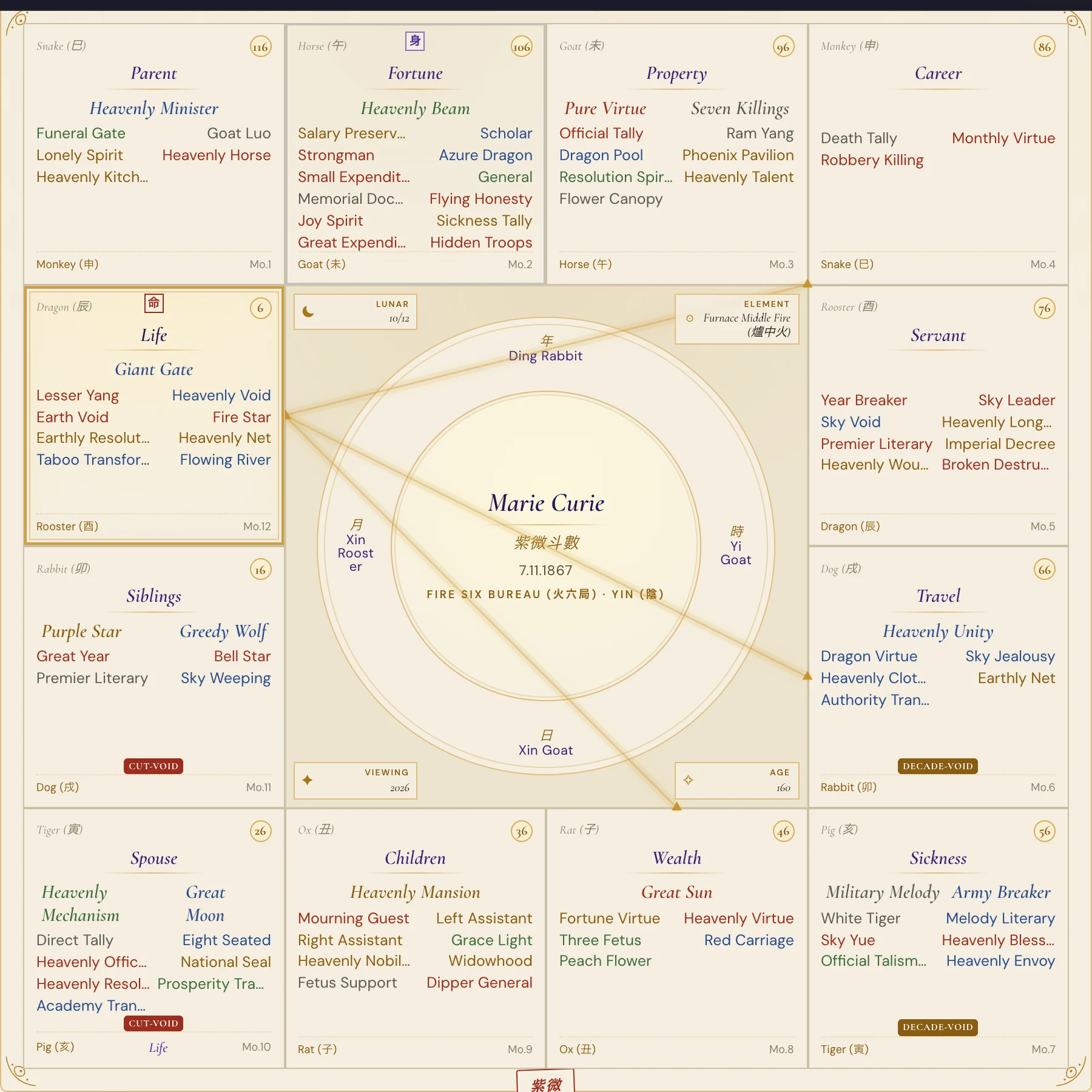
The Giant Gate star made Marie Curie both an outsider and a truth-seeker
Life Palace Palace 命宮 · Giant Gate 巨門
Giant Gate 巨門 in the Life Palace 命宮 traditionally signifies communication difficulties, social barriers, and the need to work harder than others for recognition. For Marie Curie, this manifested first as the educational barriers she faced as a Polish woman under Russian rule, then as the gender discrimination that blocked her path to higher learning. The Giant Gate's shadow fell early: denied entry to the University of Warsaw, she was forced into clandestine education through the "Flying University" and years of work as a governess before she could afford to study in Paris.
Yet Giant Gate 巨門 also bestows the ability to penetrate hidden truths, to communicate what others cannot see. Marie's doctoral research on radioactivity—choosing to investigate the mysterious "Becquerel rays" that uranium emitted—perfectly embodied this quality. While others saw uranium's glow as a curiosity, she recognized it as a window into the fundamental structure of matter itself. Her methodical isolation of polonium and radium from tons of pitchblende ore exemplified Giant Gate's patient, systematic approach to revealing what lies beneath surface appearances.
The star's influence on communication manifested in her famously reserved public persona and her preference for letting her work speak rather than engaging in academic politics. Yet when she did speak—whether defending the reality of radioactivity or training nurses in X-ray technology during World War I—her words carried the authority of someone who had genuinely penetrated nature's secrets. The Giant Gate 巨門 made her an eternal outsider who became the ultimate insider to the universe's hidden workings.
Celestial Mechanism and Moon in the Spouse Palace created both scientific partnership and profound loss
Spouse Palace Palace 夫妻宮 · Celestial Mechanism 天機 · Moon 太陰
The pairing of Celestial Mechanism 天機 and Moon 太陰 in the Spouse Palace 夫妻宮 perfectly captured Marie Curie's relationship with Pierre. Celestial Mechanism represents intellectual agility, scientific thinking, and collaborative research—precisely what drew Marie and Pierre together when she sought laboratory space in 1894. Their courtship unfolded through shared scientific discussions, and their marriage became an intellectual partnership where they developed new techniques for isolating radioactive elements and measuring their properties.
Moon 太陰 brought the emotional depth and intuitive understanding that made their collaboration transcend mere professional cooperation. Pierre provided the emotional support that allowed Marie to channel her Giant Gate intensity into sustained research rather than bitter isolation. Together, they created the conceptual framework for understanding radioactivity as a fundamental property of atoms, not merely a surface phenomenon. The Moon's influence also manifested in their domestic harmony—Marie managing both laboratory work and motherhood while maintaining the family's intellectual atmosphere.
However, Moon 太陰 traditionally carries themes of change, cycles, and sometimes sudden shifts. Pierre's death in the traffic accident of 1906 shattered this partnership at its peak, just three years after their shared Nobel Prize. The Celestial Mechanism's intellectual foundation remained—Marie continued their research methods and took over Pierre's professorship—but the Moon's emotional support vanished. Her subsequent relationship with Paul Langevin around 1910-1911, though controversial, reflected the Moon's need for emotional connection, even as the Celestial Mechanism ensured it remained grounded in scientific collaboration and intellectual exchange.
Military Music and Breaker of Armies in the Health Palace foreshadowed radiation's double-edged nature
Health Palace Palace 疾厄宮 · Military Music 武曲 · Breaker of Armies 破軍
The combination of Military Music 武曲 and Breaker of Armies 破軍 in the Health Palace 疾厄宮 created a paradox that defined Marie Curie's physical destiny. Military Music represents strength, endurance, and the ability to withstand harsh conditions—qualities Marie demonstrated throughout her career. She worked in primitive laboratory conditions, handling radioactive materials with her bare hands, carrying vials of radium salts in her pockets, and maintaining grueling research schedules that would have broken others. Her legendary discipline allowed her to process tons of pitchblende ore to extract mere grams of radium, work that required both physical stamina and mental fortitude.
Breaker of Armies 破軍, however, signifies dramatic change and potential destruction, often manifesting as sudden health crises or chronic conditions that gradually undermine the constitution. Marie's decades of unprotected exposure to ionizing radiation—at a time when its dangers were unknown—slowly poisoned her blood and bone marrow. The very radium that brought her fame literally broke down her cellular structure, leading to the aplastic anemia that would eventually kill her in 1934.
The irony runs deeper: her World War I work with mobile X-ray units, the "Little Curies," embodied both stars simultaneously. Military Music gave her the strength to organize radiological services at the front, training nurses and technicians while personally operating X-ray equipment under battlefield conditions. Yet Breaker of Armies was silently at work as each X-ray exposure added to her cumulative radiation dose. The same scientific tools that saved countless soldiers' lives were destroying their discoverer's health, cell by cell, in a process she could not yet understand or protect against.
The Sun in the Wealth Palace transformed knowledge into legacy rather than riches
Wealth Palace Palace 財帛宮 · Sun 太陽
Sun 太陽 in the Wealth Palace 財帛宮 reveals why Marie Curie chose scientific immortality over financial gain. The Sun represents illumination, generosity, and the desire to benefit humanity rather than accumulate personal wealth. Her most famous financial decision—refusing to patent the radium isolation process—perfectly embodied this solar influence. While she and Pierre could have become wealthy from their discoveries, Marie insisted that scientific knowledge should remain freely available for medical research and treatment.
This solar generosity extended beyond patents to her entire approach to wealth. Throughout her life, she lived modestly despite international fame, directing any resources toward research equipment and laboratory improvements rather than personal luxury. The Sun's influence manifested in her belief that true wealth lay in advancing human understanding—a perspective that sustained her through years of poverty as a student in Paris and continued even after her Nobel Prizes brought global recognition.
The Sun also represents lasting influence and the ability to illuminate others' paths. Marie's real wealth accumulated not in bank accounts but in the students she trained, the research institutions she established, and the scientific methods she pioneered. Her laboratory notebooks, still radioactive today, serve as both scientific documents and symbols of how she transformed personal sacrifice into intellectual capital. The Curie Laboratory became a beacon for future researchers, and her daughter Irène's Nobel Prize proved that Marie's greatest wealth was the scientific legacy she passed to the next generation.