King of Pop · 1958–2009

Why Did the King of Pop Never Stop Being a Child?

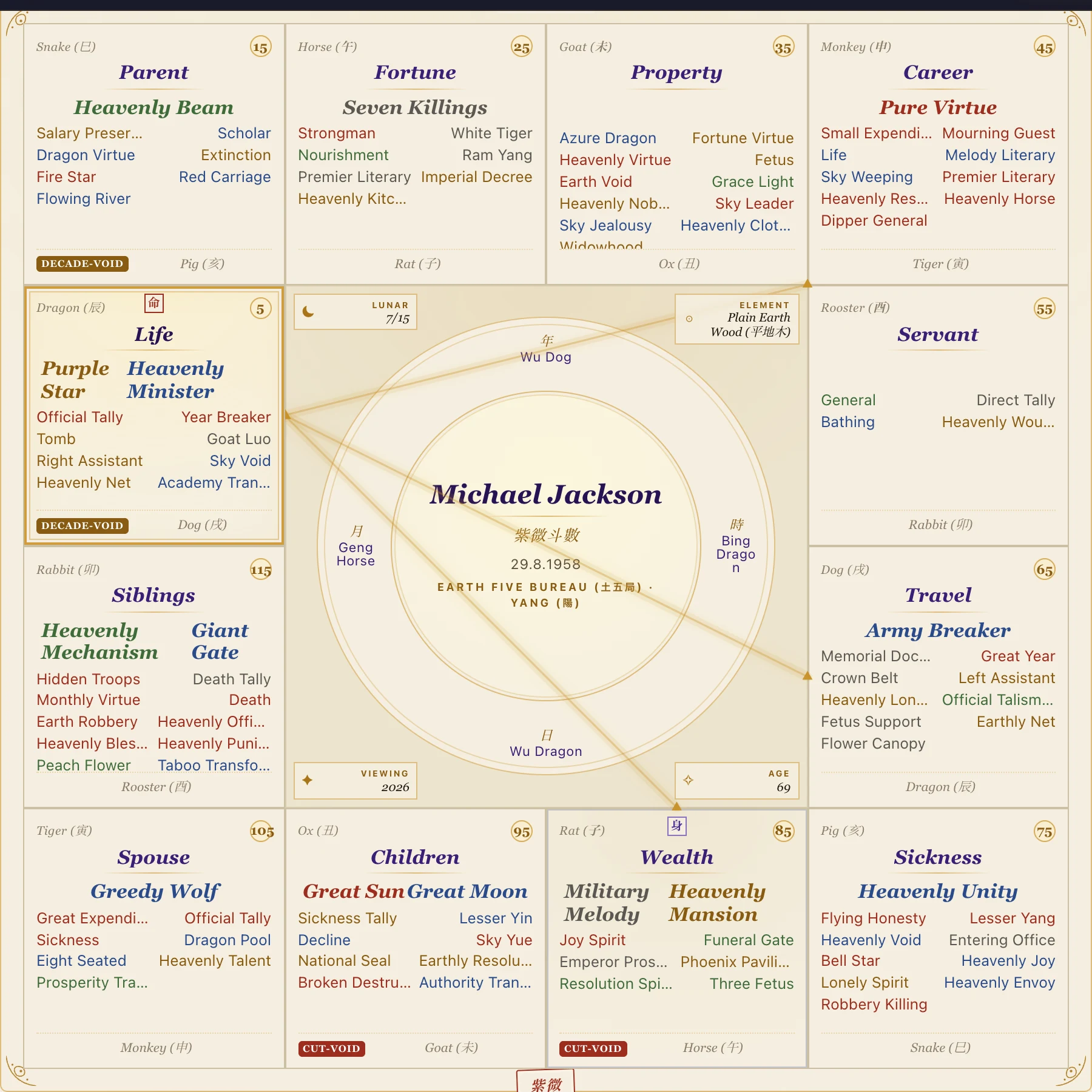
Michael Jackson’s chart crowns him twice, and in two different rooms. Purple Star 紫微, the emperor of the fourteen major stars, governs his Life Palace 命宮 — sovereignty was not something he earned in adulthood but something issued at birth, which is why the throne found him as a child. Yet the star that rules his body and vitality, over in the Health Palace 疾厄宮, is Celestial Unity 天同, the eternal child. He was built to reign and built to stay a boy, and the chart never asked him to choose between them. The Jackson 5 crowned the child; Thriller crowned the man; but the man and the child were a single configuration, read from two sides — and the empty storehouse of his Property Palace 田宅宮 quietly guaranteed that no amount of it could ever be kept.

ⓘ Birth hour inferred — Michael Jackson’s exact birth time is unrecorded. We selected the Dragon 辰 hour as the best fit among all twelve charts. Hour-dependent claims are interpretive.
Michael Jackson Purple Star Astrology chart
Born 1958-08-29·Hour: Dragon 辰 (7:00–9:00 AM)·Life Palace: Purple Star 紫微 + Celestial Minister 天相

The Chart

Earth Five Cycle | Life Palace in Dragon

Purple Star 紫微 in the Dragon 辰 is the emperor star seated in the most imperial of the twelve branches — a doubling of sovereignty. It describes the person who gravitates without effort to the centre, who needs to reign, and who carries a dignity that reads as apartness. Beside it sits Celestial Minister 天相, the star of the seal and the ceremony — of image, appearance, and impeccable presentation. Read together they are almost a costume design: the single white glove, the military jacket, the flawless staging, the sovereign who ruled through spectacle rather than speech. This is a person whose selfhood was inseparable from being watched, and being watched as a king.

His Body Palace 身宮 — the seat of what a life is ultimately for — falls in the Wealth Palace 財帛宮, among Military Music 武曲, the wealth-general, and Celestial Treasury 天府, the treasury star. That pairing is one of the strongest earning signatures in the system, and the documented Michael Jackson bears it out: for stretches of his life the highest-paid entertainer alive. But a treasury tells you only what comes in. What a chart keeps is governed by a different room entirely — the Property Palace 田宅宮, the storehouse of accumulated wealth — and there his chart holds no governing star at all. The whole financial arc of his life is written in that split: an engine built to earn colossally, wired to a vault with no lock.

Life Palace 命宮: Purple Star 紫微, Celestial Minister 天相 · Body Palace 身宮: Military Music 武曲, Celestial Treasury 天府

The Evidence

Reading the Life Through the Chart

The Child Emperor

Life Palace 命宮 · Purple Star 紫微 · Celestial Minister 天相

Purple Star 紫微 governing the Life Palace 命宮 is the signature of the born sovereign — the one who does not seek the centre so much as assume it. In the Dragon 辰 the placement is doubly imperial, and it carries the emperor star’s shadow as plainly as its dignity: a remoteness, a difficulty being merely one person among others, a self that only feels real when it is enthroned. The documented Michael Jackson is startlingly consistent with it. He was, from childhood, most himself under lights and least himself off them.

Celestial Minister 天相 at its side is the star of image and ceremony — the impeccable seal, the perfect surface. It is the faculty that turns a performer into an icon: the obsessive control of appearance, the staging, the costume that becomes a coat of arms. But 紫微 and 天相 together also describe a monarch who needs ministers — a sovereignty that is oddly dependent, that must be surrounded, advised, and served to function. A king crowned before he could choose it, ruling through an image so perfected it slowly replaced the man inside it.

The World-Breaker

Travel Palace 遷移宮 · Breaker of Armies 破軍

The Travel Palace 遷移宮 is how the world receives a person when they step out into it — the public face on the move, the reception abroad. Michael Jackson’s holds Breaker of Armies 破軍, the star of pioneering destruction: the force that shatters existing forms in order to build something without precedent. It is the least conservative star in the system, and in the palace of how-the-world-sees-you it reads almost literally.

He broke every rule of what a performer could be. The moonwalk was not a new step but a refusal of how steps were supposed to work; the short film replaced the music video; the live spectacle was rebuilt from the ground up. Breaker of Armies 破軍 does not refine an inherited form — it demolishes and re-founds — and that is the shape of a career that left popular music permanently unable to return to what it had been before him. The same star warns of a life lived in extremes of upheaval, never settling into the established, always tearing down the version that just triumphed.

The Solitary General

Fortune Palace 福德宮 · Seven Killings 七殺

The Fortune Palace 福德宮 is where a chart keeps its inner weather — the private emotional and spiritual life behind the public face. Michael Jackson’s is governed by Seven Killings 七殺, the lone general: driven, disciplined to the point of severity, and profoundly solitary. It is a star of relentless internal command, of a perfectionism that permits no rest, and it does not know how to be at ease with itself.

This is the engine behind the legend of the workroom — the take repeated a hundred times, the choreography drilled past exhaustion, the standard no collaborator could quite meet. But 七殺 in the seat of inner life exacts a documented price: the isolation at the summit, the sense of being surrounded and yet unreached, the difficulty simply resting inside one’s own mind. The child emperor of the Life Palace was adored by the world; the general of the Fortune Palace stood, inwardly, alone.

The Body of the Eternal Child

Health Palace 疾厄宮 · Celestial Unity 天同

Here the chart turns tender and, in hindsight, sorrowful. The Health Palace 疾厄宮 — the palace of the body and its vitality — is governed by Celestial Unity 天同, the gentlest of the fourteen major stars and the star of the eternal child: emotional purity, play, blessing, an allergy to hardship. In the palace of the body it describes a constitution that stays, in some essential way, childlike — and that wilts, rather than hardens, under adversity.

The biography is almost too consistent with it. The fairground built at home, the animals, the reluctance to leave childhood behind at all — Celestial Unity 天同 is the Peter Pan star, and Neverland was its monument. But 天同 has no armour for hardship, and a body it governs is more fragile than the sovereign image it wears. The sleepless perfectionist reaching for something to make the child rest, the sudden and premature failure of a constitution built for delight rather than endurance — the chart drew that vulnerability into the very palace of the body long before 2009 gave it a date.

The Empty Storehouse

Property Palace 田宅宮 · (no major star)

In Purple Star Astrology the Property Palace 田宅宮 is more than the home — it is the storehouse, the room that measures what a life manages to accumulate and hold. Michael Jackson’s holds none of the fourteen major stars; it is 無正曜, an empty storehouse. Set beside the formidable earning engine of his Body-and-Wealth Palace — Military Music 武曲 with Celestial Treasury 天府 — it produces the exact paradox of his finances: colossal income pouring into a vault with no governing structure to keep it.

Money on this scale arrives and disperses; assets are acquired and do not settle; the estate itself becomes the emblem of the leak. That one of the highest earners in the history of entertainment could carry enormous debt is not a contradiction the chart cannot explain — it is the chart’s plainest statement. The treasury was real. The storehouse was empty. The decade his life ran through this palace, roughly his late thirties into his forties, was also his documented wilderness — the years the outflow finally overtook even his extraordinary capacity to earn.

The Sun and Moon Over the Children

Children Palace 子女宮 · Sun 太陽 · Moon 太陰

The Children Palace 子女宮 holds both luminaries at once — the Sun 太陽 and the Moon 太陰, full day and full night in a single room. Both are radiant stars, and together they promise a relationship to children that is enormous, luminous, and impossible to keep private. In a chart whose owner made childhood itself his subject and his cause, the concentration of both lights in this exact palace is striking.

But Sun and Moon together are also the signature of extremes held in tension — dazzling brightness and deep shadow, often over the same ground. The palace that gave him a profound, public devotion to children was the same palace that drew the most contested and painful chapter of his life. The chart does not adjudicate; it insists both are the same configuration. The luminous public tenderness and the shadow that fell across it are not two stories to be sorted into true and false — they are the Sun and the Moon, sharing one house, as this chart placed them from birth.
The Arc of a Life

Decade Cycles 大限

Age 5–14 · c.1963–1972

Life Palace 命宮 · Purple Star 紫微 + Celestial Minister 天相

Events: The Jackson 5 years: performing from early childhood, the Motown breakthrough, a global child star before adolescence.

Reading: The first decade runs straight through the Life Palace, front-loading the chart’s sovereignty. Purple Star 紫微 crowns the child; Celestial Minister 天相 supplies the mastery of image and staging that made him an icon before he was a teenager.

Age 15–24 · c.1973–1982

Parents Palace 父母宮 · Celestial Beam 天梁

Events: The passage to a solo artist under the guidance of elders and mentors; Off the Wall (1979); the recording of Thriller, released at the close of this decade.

Reading: Celestial Beam 天梁 is the star of the elder, the mentor, and oversight — and this was the decade of Quincy Jones and of a young man still working under the authority and patronage of others before stepping into his own reign.

Age 25–34 · c.1983–1992

Fortune Palace 福德宮 · Seven Killings 七殺

Events: The imperial solo peak: Thriller’s global reign, Bad, Dangerous, the moonwalk, world tours, and total cultural domination.

Reading: Seven Killings 七殺 — the lone, driven general — governs the peak years from the inside. The relentless perfectionism and reinvention that built the legend are the star working at full power, and so is the solitude that came with standing at the summit alone.

Age 35–44 · c.1993–2002

Property Palace 田宅宮 · no major star 無正曜

Events: Neverland; the first allegations (1993) and settlement; mounting debt against the estate; the beginning of a long public wilderness.

Reading: The cycle turns to the empty storehouse. A Property Palace with no governing star gives a home and a fortune no native structure to hold; the fantasy estate that should have been the vault became the emblem of the leak.

Age 45–54 · c.2003–2012

Career Palace 官祿宮 · Pure Virtue 廉貞

Events: The 2005 trial and acquittal, retreat, then the announcement of the “This Is It” comeback residency — and death in June 2009, at fifty, before it could open.

Reading: Pure Virtue 廉貞 — the complex star of passion and discipline, and his own Life Master 命主 — governs a final decade of reckoning and attempted return. The comeback was the chart reaching for its throne one last time; the reign ended before the curtain rose.

The Verdict

Michael Jackson’s chart does not read as an ordinary rise and fall. It reads as a sovereignty issued too early and a childhood that was never allowed to close. Purple Star 紫微 crowned him in the Life Palace 命宮 while Celestial Unity 天同 kept the eternal child alive in the Health Palace 疾厄宮 — king and boy in the same person, never reconciled. Breaker of Armies 破軍 sent that figure into the world to shatter every form it found, and Seven Killings 七殺 drove it from within without rest. And beneath the record-breaking treasury of his Body Palace sat the empty storehouse of his Property Palace 田宅宮, ensuring that a man who earned more than almost anyone would die holding little of it. The genius, the strangeness, and the ruin are not three stories. They are one chart, read room by room.

A crown handed to a child is not a gift so much as a sentence — it fuses the self to being watched before the self has formed, and it makes ordinary adulthood feel like exile from the throne. And a life that can earn without limit still needs a room built to hold what it earns. Michael Jackson’s chart is a quiet warning that brilliance and even sovereignty are not the same as the humbler faculties — rest, boundaries, the ability to keep — that let a person actually live inside a life instead of only reigning over it.

About This Reading

Michael Jackson’s exact birth hour was never publicly recorded, and the birth hour fixes the Life Palace 命宮 on which this whole reading turns. We inferred the most likely hour — the Dragon hour 辰 — by casting the candidate charts and choosing the one whose palaces best fit his documented life, then read that chart. Every star named here is taken from that computed chart, not chosen to suit the story; but because the hour is inferred, treat the hour-dependent claims as interpretation rather than settled fact. The biographical events are drawn from the public record; the astrology is our reading of them.

  • Public birth record, Gary, Indiana (29 August 1958)
  • Contemporary reporting on his career, 1969–2009 — the Jackson 5, the Thriller-era peak, and the later trials
  • Los Angeles County Coroner findings on his death, June 2009

What does your chart reveal?

Calculate your free chart →