The Evidence
Reading the Life Through the Chart
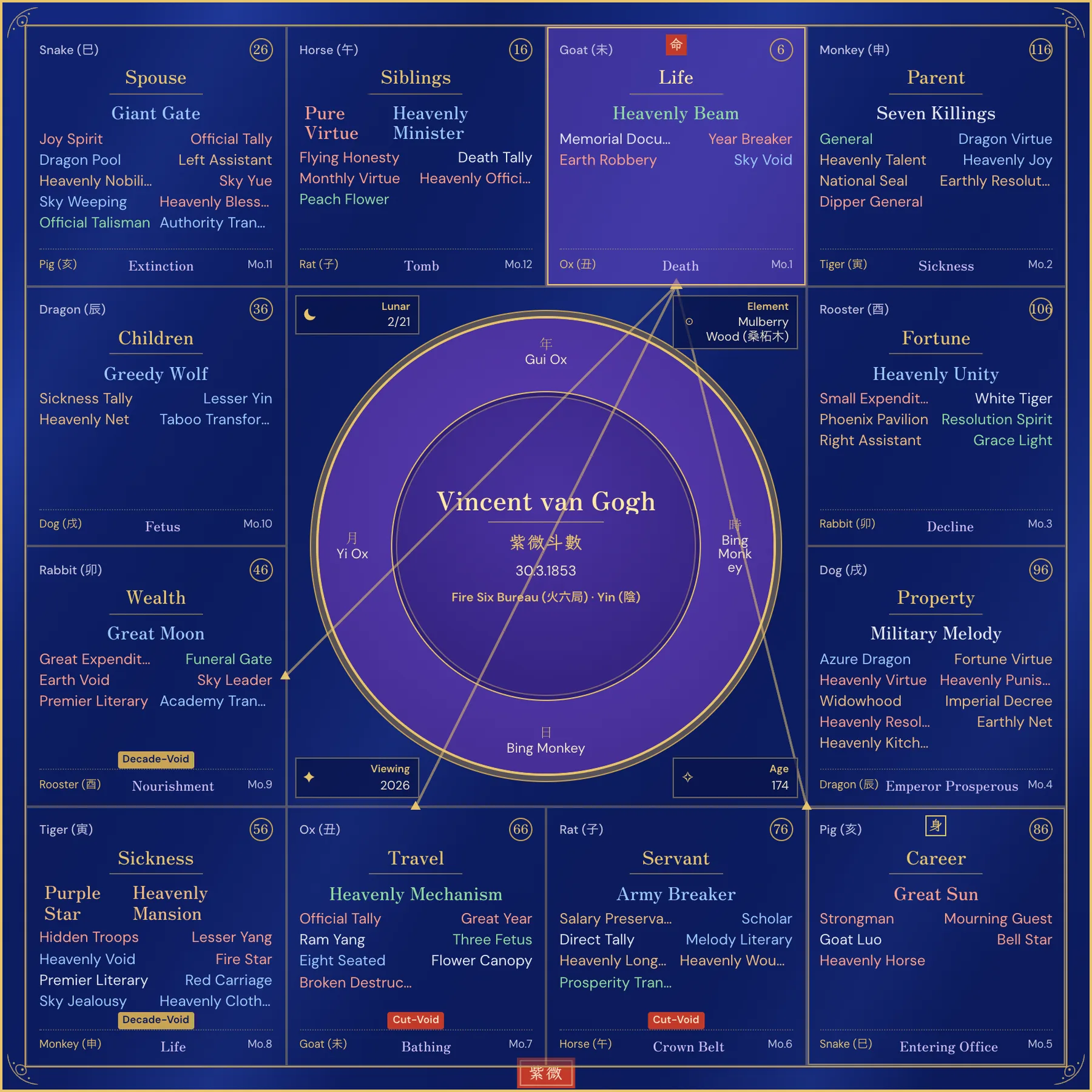
His Life Palace placement of Celestial Beam 天梁 manifested as a compulsion to serve humanity through art, even at the cost of personal happiness
Life Palace 命宮 Palace 命宫 · Celestial Beam 天梁
Celestial Beam 天梁 in the Life Palace creates individuals who feel responsible for uplifting humanity, often through teaching or guidance that comes at personal sacrifice. Van Gogh exemplified this pattern with startling precision. His letters to his brother Theo repeatedly express his belief that art should serve the poor and working class, writing 'I want to touch people with my art.' This was not mere artistic ambition but a spiritual mission—he painted peasants, laborers, and the forgotten with a reverence typically reserved for religious subjects.
The star's influence appears in his famous statement that he wanted to become 'the painter of peasants' and his decision to live in poverty among the people he painted. In Arles, despite his deteriorating mental state, he continued producing works at an almost supernatural pace, as if driven by an urgent need to complete his message to humanity. Celestial Beam natives often sacrifice personal comfort for their calling, and van Gogh's willingness to live in squalor while creating masterpieces reflects this star's demanding nature.
Most tellingly, van Gogh's art consistently showed ordinary subjects transformed by an almost divine light—his sunflowers, starry nights, and humble rooms radiate with spiritual significance. This transformation of the mundane into the sacred is Celestial Beam's signature gift. He was not painting objects but illuminating truth, serving as humanity's teacher even when humanity rejected the lesson.
The Sun 太陽 in his Career Palace 官祿宮 created both his artistic brilliance and his complete failure to achieve worldly recognition during his lifetime
Career Palace 官祿宮 Palace 官禄宫 · Sun 太陽
The Sun 太陽 in the Career Palace typically bestows leadership, recognition, and noble reputation—yet van Gogh sold only one painting in his entire career and died unknown. This apparent contradiction reveals the Sun's deeper nature: it illuminates truth regardless of whether society is ready to see it. Van Gogh's career was that of a sun shining in darkness, providing light that would only be appreciated once eyes adjusted to its brilliance.
The Sun's influence manifests in the sheer luminosity of van Gogh's work—his use of yellow, his fascination with sunlight, and his ability to make colors seem to glow from within. His paintings of sunflowers became iconic precisely because they captured the Sun's life-giving energy. But the Sun in Career also demands integrity above popularity, and van Gogh refused to compromise his vision for commercial success. He painted what he felt compelled to paint, not what would sell.
Most significantly, the Sun ensures eventual recognition, though often posthumously for those born to be ahead of their time. Van Gogh's complete obscurity during life followed by his emergence as one of art history's brightest stars perfectly exemplifies this pattern. The Sun had placed him in a career where he would become humanity's guide to seeing beauty and meaning in existence—but like the actual sun, his light was too intense for direct gaze during his lifetime.
Giant Gate 巨門 in his Spouse Palace 夫妻宮 explains his pattern of intense but failed romantic connections and ultimate isolation in love
Spouse Palace 夫妻宮 Palace 夫妻宫 · Giant Gate 巨門
Giant Gate 巨門 in the Spouse Palace creates individuals whose deep emotional intensity and need for authentic connection often overwhelms potential partners, leading to a pattern of meaningful but unsuccessful relationships. Van Gogh's romantic history perfectly illustrates this challenging placement. His passionate but unrequited love for his cousin Kee Vos-Stricker, whom he pursued with desperate intensity after she rejected him, shows Giant Gate's tendency toward all-consuming emotional expression that frightens others away.
The star's influence appears in van Gogh's letters about love, which reveal someone who understood relationships as spiritual unions rather than social arrangements. He wrote to Theo about wanting to find a woman who could share his artistic vision and bear the isolation that came with his calling. This idealistic approach to love, while noble, made him incompatible with the practical marriage expectations of his era.
Giant Gate also manifests as eloquent expression of deep truths, and van Gogh's most profound relationships were ultimately with his art and his correspondence with Theo. His paintings became his lovers—he poured the intensity that might have gone into marriage into canvases that received and reflected his passion without judgment. The star's gift for authentic communication found its outlet in his letters, which remain among history's most moving documents of artistic dedication. His isolation in love became the fuel for artistic intimacy with universal human experience.
Seven Killings 七殺 in his Parents Palace 父母宫 shaped his complex relationship with authority and his need to rebel against traditional paths to success
Parents Palace 父母宫 Palace 父母宫 · Seven Killings 七殺
Seven Killings 七殺 in the Parents Palace typically indicates a challenging relationship with parental authority and traditional expectations, often manifesting as a need to forge an entirely independent path. Van Gogh's relationship with his father, Theodorus—a respected Dutch Reformed minister—exemplified this tension. Despite being raised in a religious household that valued conventional success and social respectability, Vincent repeatedly chose paths that embarrassed and worried his family.
The star's rebellious energy appears in van Gogh's dramatic career changes: abandoning a promising position as an art dealer, failing at theological studies despite his family's religious background, and ultimately choosing the impoverished, socially marginal life of an artist. Each decision directly contradicted his parents' hopes for stability and respectability. Seven Killings natives often must break completely from family expectations to find their true calling.
Yet the star also grants fierce independence and the courage to pursue one's authentic path regardless of opposition. Van Gogh's willingness to live in poverty, to paint subjects considered unworthy by academic standards, and to develop a radical artistic style that challenged every contemporary convention shows Seven Killings' gift for revolutionary action. His father's death in 1885 coincided with van Gogh's emergence as a truly original artist, as if breaking the final parental bond freed him to fully embrace his destiny as an artistic revolutionary who would transform how humanity sees beauty.