The Evidence
Reading the Life Through the Chart
The Eternal Child
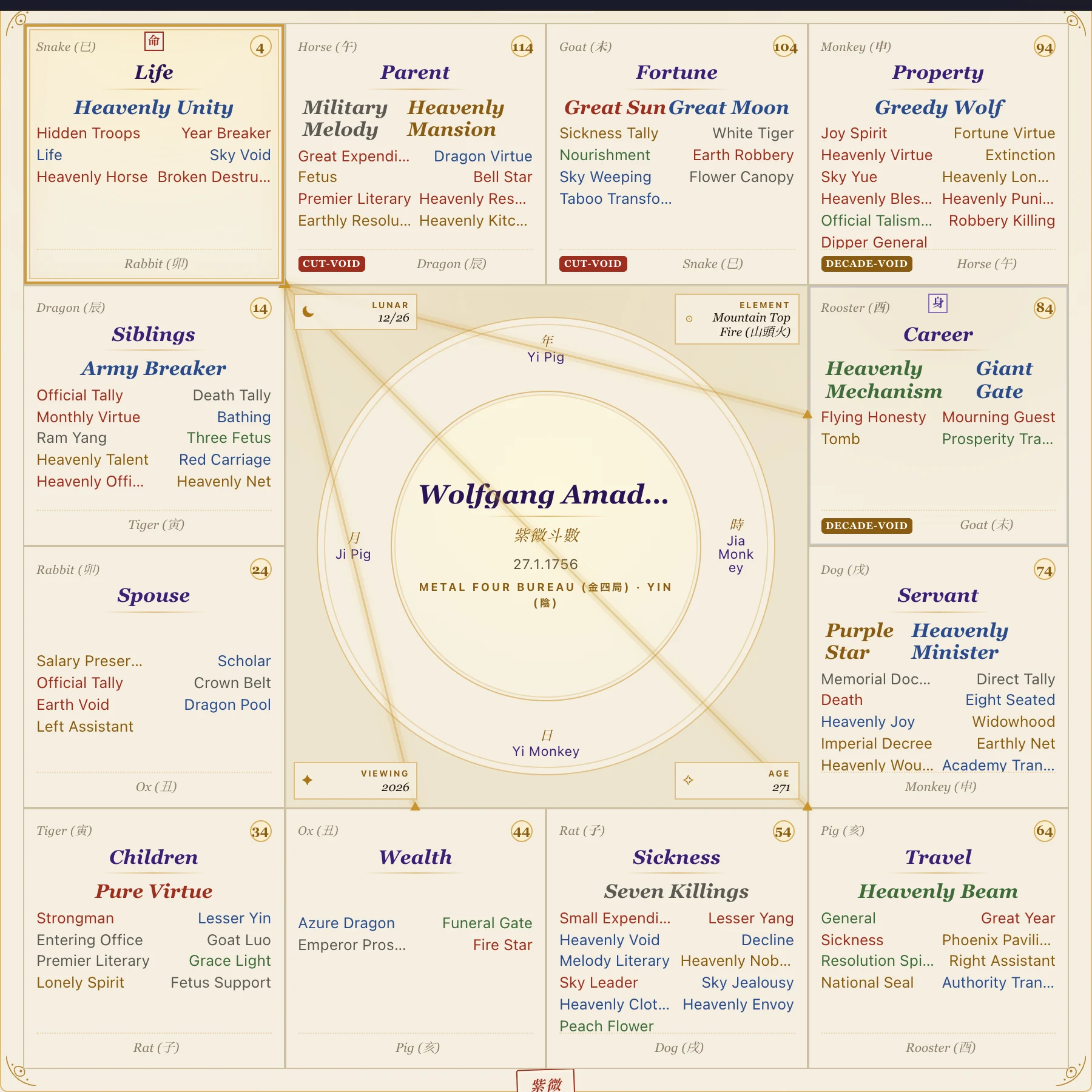
Life Palace 命宮 · Celestial Unity 天同 · Celestial Horse 天馬
Celestial Unity 天同 governing the Life Palace 命宮 is the signature of the person to whom things come easily — and who is, for that reason, poorly armoured against the things that do not. In its bright placement in the Snake 巳 it gives charm, musicality, emotional openness, and an almost unguarded joy. The documented Mozart is startlingly consistent with it: playful to the point of childishness, scatological in his letters, weeping and laughing without concealment, composing as though taking dictation.
The Celestial Horse 天馬 at its side is the star of the road. Read against a life that began touring at six and never settled into a stable post, it stops being a symbol and becomes a fact. But 天同 has a shadow the tradition is blunt about: it does not build discipline, it does not husband resources, and it wilts in adversity. The gift that needed no struggle also never taught him to struggle.
A Mind That Could Not Stop Turning
Career Palace 官祿宮 · Celestial Mechanism 天機 · Giant Gate 巨門 · Transform Wealth 化祿
The Body Palace 身宮 — the seat of what a life is ultimately about — falls here, in the Career Palace 官祿宮, and that alone tells us Mozart’s centre of gravity was his work. Celestial Mechanism 天機 is ingenuity itself: the restless, calculating, ever-revolving mind, which in a composer reads as the capacity to hear whole structures turning at once. The Transform Wealth 化祿 lands in this same palace, meaning his fortune genuinely did flow through his craft rather than through inheritance or marriage.
But Giant Gate 巨門 sits beside it, and 巨門 is the star of the mouth — brilliant in expression and prone to friction, to being misunderstood, to quarrel. Mozart’s violent 1781 break with the Archbishop of Salzburg, his prickly dealings with patrons, his sense of being underrated in Vienna: these are the Giant Gate 巨門 working exactly as described. The same star that sharpened his voice sharpened his conflicts.
The Empty Treasury
Wealth Palace 財帛宮 · (no major star) · Fire Star 火星
Here the chart is at its most quietly devastating. Mozart’s Wealth Palace 財帛宮 holds none of the fourteen major stars — it is 無正曜, an empty treasury — and the only bright presence in it is the Fire Star 火星, a fast, hot, unstable influence. A wealth palace with no governing star has no native structure for money; the Fire Star 火星 supplies heat without holding. Money arrives, flares, and is gone.
The decade cycles confirm the pattern rather than soften it. His great Vienna years, roughly ages twenty-four to thirty-three, ran through the Spouse decade 夫妻宮, which carries Wealth Preservation 祿存 — the treasury star — shadowed by the Earthly Void 地空 — income earned and income voided in the same breath. He commanded large fees at his peak and was writing desperate begging letters within a few years. The chart did not deny him earnings. It denied him a vessel to keep them in.
The Sun and Moon in Shadow
Fortune Palace 福德宮 · Sun 太陽 · Moon 太陰 · Transform Obstruction 化忌
The Fortune Palace 福德宮 is where a chart keeps its inner weather — the emotional and spiritual life behind the public face. Mozart’s holds both luminaries at once, the Sun 太陽 and the Moon 太陰, and over them falls the Transform Obstruction 化忌. Sun and Moon together give a temperament of extremes: dazzling brightness and sudden depth of melancholy, often in the same day. The Transform Obstruction 化忌 does not let that inner life rest.
This is the shadow beneath the sunny child of the Life Palace — the darkness in the late G minor works, the grief that runs under the comedy. The chart insists both are real: the effortless delight and the unresting sorrow are not a contradiction to be explained away but a single configuration, read from the inside.
The Body That Broke Suddenly
Health Palace 疾厄宮 · Seven Killings 七殺 · Literary Arts 文曲
Seven Killings 七殺 governing the Health Palace 疾厄宮 is the mark of a constitution that runs hard and fails fast — not the slow decline of a wasting star but the sudden, decisive break. It warns of acute crisis rather than long illness. Mozart’s end fits it precisely: a final year of feverish output, including the unfinished Requiem, cut off by a short and violent illness whose exact cause is still debated.
He died in December 1791, at thirty-five, in the decade that had turned to his Children Palace 子女宮 — a palace carrying Pure Virtue 廉貞 ground down by the grinding Spinning Top 陀羅, and, poignantly, the same palace that had already seen four of his six children die in infancy. Read against the chart, the medical particulars matter less than the shape the stars had drawn: a body built for brilliance, not endurance, reaching its limit early.