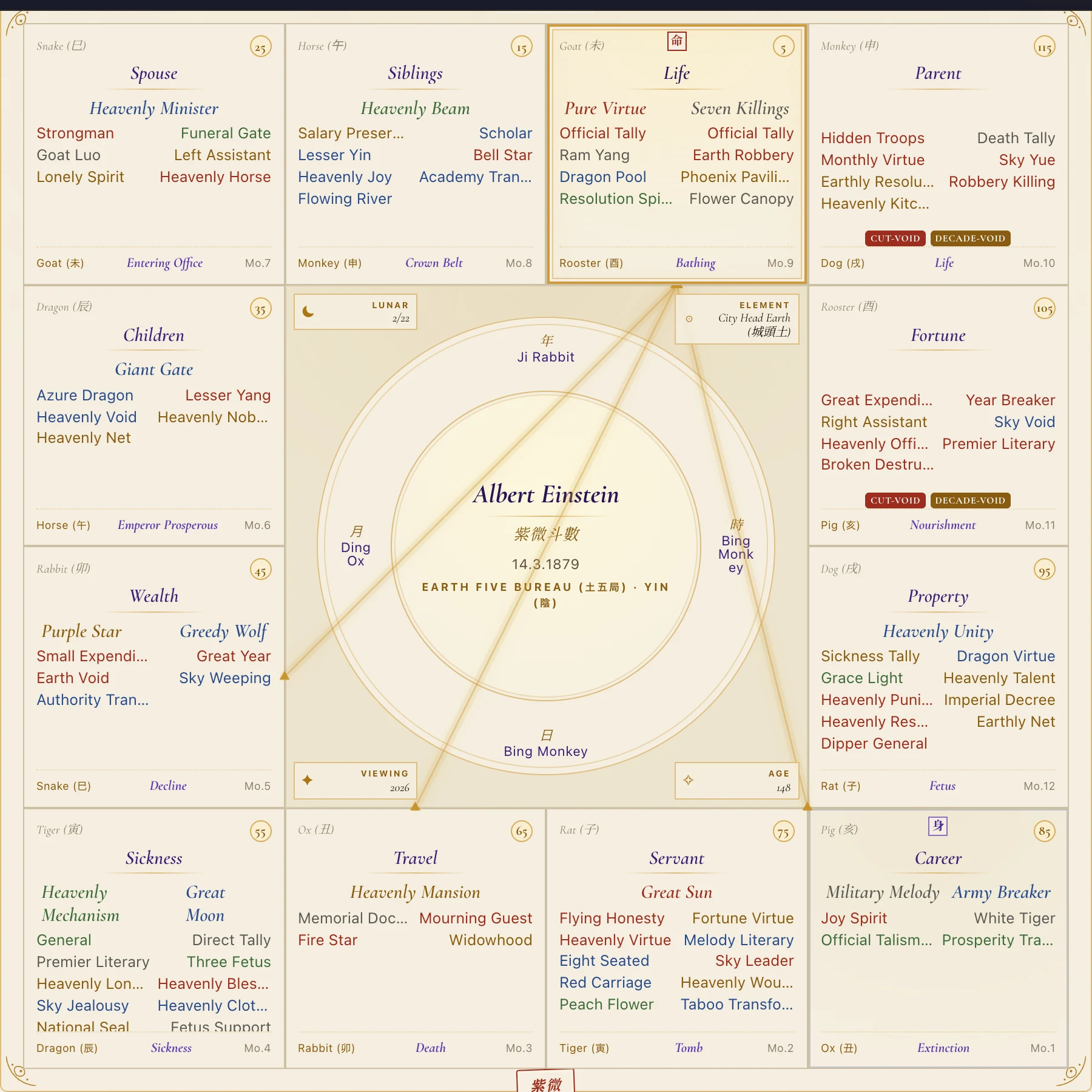
The Evidence
Reading the Life Through the Chart
Einstein's revolutionary mindset emerged from the cosmic tension between preservation and destruction
Life Palace Palace 命宮 · Pure Virtue 廉貞 · Seven Killings 七殺
The presence of Pure Virtue 廉貞 and Seven Killings 七殺 in Einstein's Life Palace 命宮 created a fundamental paradox that drove his entire existence. Pure Virtue 廉貞 represents the impulse toward perfection, correctness, and the preservation of universal principles—exactly the mindset needed to discern the mathematical elegance underlying physical reality. Yet Seven Killings 七殺 brings the warrior's instinct to completely demolish existing structures, to attack established systems with relentless force.
This combination manifested most dramatically in his annus mirabilis of 1905, when Einstein simultaneously preserved the fundamental constants of physics (the speed of light) while completely destroying Newton's absolute space and time. His special relativity didn't merely modify classical mechanics—it annihilated the very foundations of how humanity understood reality. The same pattern repeated with general relativity in 1915, where his reverence for mathematical beauty led him to overthrow even his own earlier work.
Personally, this Pure Virtue-Seven Killings dynamic created endless internal conflict. Einstein preserved his commitment to pacifist principles throughout World War I, even as his German colleagues embraced militarism. Yet when faced with Nazi aggression, he abandoned pure pacifism entirely, urging Roosevelt to develop atomic weapons. He preserved his marriage to Mileva for over a decade while systematically destroying it through neglect and infidelity. The man who sought cosmic harmony lived in perpetual personal discord.
Most tellingly, Einstein spent his final thirty years attempting to preserve physics by destroying it—searching for a unified field theory that would reduce all forces to a single, elegant framework. His Pure Virtue 廉貞 demanded this ultimate theoretical perfection, while his Seven Killings 七殺 compelled him to reject quantum mechanics, the very theory his earlier work had helped establish. He died still fighting this war between preservation and destruction.
His scientific breakthroughs stemmed from an obsession with career transformation and military-like precision
Career Palace Palace 官祿宮 · Military Music 武曲 · Breaker of Armies 破軍
Einstein's Career Palace 官祿宮 houses Military Music 武曲 alongside Breaker of Armies 破軍, a combination that reveals the true nature of his professional methodology. Military Music 武曲 represents systematic, disciplined pursuit of concrete results—the methodical approach of an engineer or patent examiner. Breaker of Armies 破軍 brings the capacity for complete professional reinvention, the willingness to abandon established career paths entirely.
This pattern perfectly explains Einstein's career trajectory. His years at the Swiss Patent Office (1902-1909) exemplify Military Music 武曲 in action—he approached each patent application with systematic rigor, developing an almost military discipline in analyzing technical problems. This training in precise, methodical thinking became the foundation for his theoretical work. His 1905 papers didn't emerge from romantic inspiration but from the patent clerk's habit of reducing complex problems to their essential components.
Yet Breaker of Armies 破軍 drove his constant professional transformation. He abandoned the security of the patent office for academic uncertainty in 1909, then repeatedly uprooted himself—Zurich to Prague to Zurich to Berlin to Princeton. Each move represented a complete break with his previous professional identity. Most dramatically, at age fifty-four, he abandoned his established European career entirely, fleeing Nazi Germany to rebuild his professional life in America.
The Military Music-Breaker of Armies combination also shaped his approach to physics itself. He attacked scientific problems with military precision, marshaling mathematical tools like a general deploying forces. Yet he repeatedly broke apart entire theoretical armies—abandoning classical physics for relativity, then spending decades trying to break apart quantum mechanics. His search for unified field theory represented the ultimate Military Music 武曲 campaign: the systematic conquest of all physical forces under a single theoretical framework.
Einstein's complex relationship patterns reflected deeper struggles with intimacy and control
Spouse Palace Palace 夫妻宮 · Celestial Minister 天相
Celestial Minister 天相 in Einstein's Spouse Palace 夫妻宮 reveals a man who approached marriage with the mindset of a careful administrator rather than a passionate romantic. Celestial Minister represents measured judgment, formal arrangements, and the ability to maintain proper relationships—but it also indicates emotional distance and a tendency to treat intimate partnerships as management problems rather than deep emotional bonds.
This pattern dominated Einstein's first marriage to Mileva Marić. Their relationship began as an intellectual partnership between fellow physics students, exactly the kind of measured, rational arrangement that Celestial Minister 天相 favors. Einstein appreciated Mileva's mathematical abilities and treated their marriage as a collaborative venture. However, as domestic responsibilities increased—especially after the birth of their sons Hans Albert and Eduard—Einstein began managing the relationship with bureaucratic detachment.
The infamous "marriage contract" Einstein proposed to Mileva in 1914 perfectly exemplifies Celestial Minister energy: he literally created administrative rules for their cohabitation, including stipulations that she maintain his clothes and serve him meals without expecting personal conversation. This wasn't cruelty but rather the natural response of someone whose Spouse Palace operates through formal structures rather than emotional intimacy.
His second marriage to his cousin Elsa Einstein followed the same pattern. Elsa essentially became his personal administrator, managing his correspondence, social calendar, and daily needs. Einstein found this arrangement satisfying precisely because Celestial Minister 天相 thrives on well-organized, clearly defined relationships. Elsa understood her role and performed it efficiently, creating the stable domestic framework that allowed Einstein to focus on physics. Yet even this more successful marriage maintained the emotional distance characteristic of Celestial Minister—partnership without deep vulnerability, affection without passionate connection.
His relationship with his children revealed the struggle between intellectual brilliance and emotional availability
Children Palace Palace 子女宮 · Giant Gate 巨門
Giant Gate 巨門 in Einstein's Children Palace 子女宮 created profound challenges in his relationships with his offspring, particularly around communication and emotional expression. Giant Gate represents intense scrutiny, critical analysis, and the tendency to approach relationships through intellectual rather than emotional channels. While this energy can produce deep insights, it often manifests as harsh judgment and difficulty expressing unconditional love.
Einstein's relationship with his eldest son Hans Albert exemplifies both the gifts and burdens of Giant Gate 巨門. He subjected Hans Albert to intense intellectual scrutiny, closely monitoring his academic progress and career choices. When Hans Albert chose hydraulic engineering over theoretical physics, Einstein's Giant Gate energy emerged as sharp criticism and disappointment. Yet this same analytical intensity also allowed Einstein to recognize and nurture his son's genuine talents, eventually leading to Hans Albert's distinguished academic career.
The tragic situation with his younger son Eduard revealed Giant Gate's darker potential. Eduard's developing schizophrenia triggered Einstein's most intense analytical response—he researched psychiatric literature extensively, consulted multiple specialists, and approached his son's illness as a theoretical problem to be solved. However, Giant Gate's critical nature made emotional support nearly impossible. Einstein struggled to provide the unconditional acceptance Eduard needed, instead focusing on finding rational explanations and practical solutions.
Most painfully, Giant Gate 巨門 created communication barriers that persisted throughout Einstein's life. His letters to his children often read more like scientific correspondence than paternal expressions of love. He analyzed their personalities, critiqued their choices, and offered detailed advice, but rarely communicated simple emotional warmth. The man who could explain the universe's deepest mysteries found himself unable to express basic paternal affection, creating lasting emotional wounds that neither his intellectual brilliance nor genuine concern could heal.
Einstein's approach to money and material security reflected deep philosophical conflicts about value and meaning
Wealth Palace Palace 財帛宮 · Purple Star 紫微 · Greedy Wolf 貪狼
The combination of Purple Star 紫微 and Greedy Wolf 貪狼 in Einstein's Wealth Palace 財帛宮 created a fascinating contradiction in his relationship with material resources. Purple Star represents imperial dignity, the natural assumption that one deserves respect and adequate resources without having to pursue them aggressively. Greedy Wolf brings intense desire for acquisition and the ability to pursue multiple sources of value simultaneously. Together, they created a man who both expected material security and felt uncomfortable with its pursuit.
Einstein's early career perfectly illustrates this dynamic. His Purple Star 紫微 nature made him unsuited for aggressive job hunting or financial networking—he simply assumed his obvious brilliance would be recognized and rewarded appropriately. When academic positions didn't materialize immediately after graduation, he found himself working at the Swiss Patent Office, a position that wounded his Purple Star dignity but provided the Greedy Wolf security he needed to pursue theoretical research.
The Nobel Prize money situation reveals both stars in operation. When Einstein assigned his 1921 Nobel Prize money to his ex-wife Mileva as part of their divorce settlement, he demonstrated Purple Star's imperial generosity—the belief that truly important people rise above material concerns. Yet his Greedy Wolf energy had already calculated this as a strategic investment, ensuring his children's financial security while maintaining his reputation as a man of principle.
Later in life, Einstein's relationship with his growing celebrity status showed Greedy Wolf's influence. While he maintained Purple Star dignity by refusing commercial endorsements or celebrity appearances, he skillfully leveraged his fame for causes he valued—raising funds for Jewish refugees, promoting civil rights, and advocating for nuclear disarmament. He had learned to satisfy Greedy Wolf's acquisitive nature by accumulating moral rather than material capital, building a treasure house of global respect that proved far more valuable than mere money.
His lifelong search for unified field theory emerged from an obsession with creating perfect theoretical harmony
Property Palace Palace 田宅宮 · Celestial Unity 天同
Celestial Unity 天同 in Einstein's Property Palace 田宅宮 reveals his deep psychological need to create unified, harmonious theoretical frameworks that could serve as permanent intellectual foundations. Celestial Unity represents the drive toward synthesis, integration, and the establishment of peaceful, stable systems. In the Property Palace, this energy manifests as the desire to build lasting intellectual estates rather than temporary theoretical constructions.
Einstein's approach to physics consistently reflected this Celestial Unity 天同 drive toward unification. His special relativity didn't merely solve specific problems in electromagnetism—it created a unified framework that integrated space and time into a single theoretical structure. General relativity extended this unifying impulse further, bringing gravity into harmony with the geometry of spacetime. Each breakthrough represented Einstein's attempt to build increasingly comprehensive theoretical "properties" that could house all physical phenomena.
This same energy drove his famous resistance to quantum mechanics, particularly the probabilistic interpretation developed by Bohr and Heisenberg. Einstein's "God does not play dice" wasn't mere conservatism but the expression of Celestial Unity's need for harmonious, deterministic systems. Quantum uncertainty violated his deep psychological requirement for theoretical frameworks that unified all phenomena under elegant, predictable laws.
Most significantly, Einstein spent his final thirty years pursuing the ultimate expression of Celestial Unity—a unified field theory that would integrate electromagnetism, gravity, and nuclear forces into a single theoretical framework. This wasn't just scientific ambition but psychological necessity. His Property Palace demanded the construction of a permanent theoretical foundation that could house all physical reality. Though he died without achieving this unification, the search itself perfectly exemplified Celestial Unity's drive to build comprehensive, harmonious systems that transcend temporary solutions or partial explanations.