The Evidence
Reading the Life Through the Chart
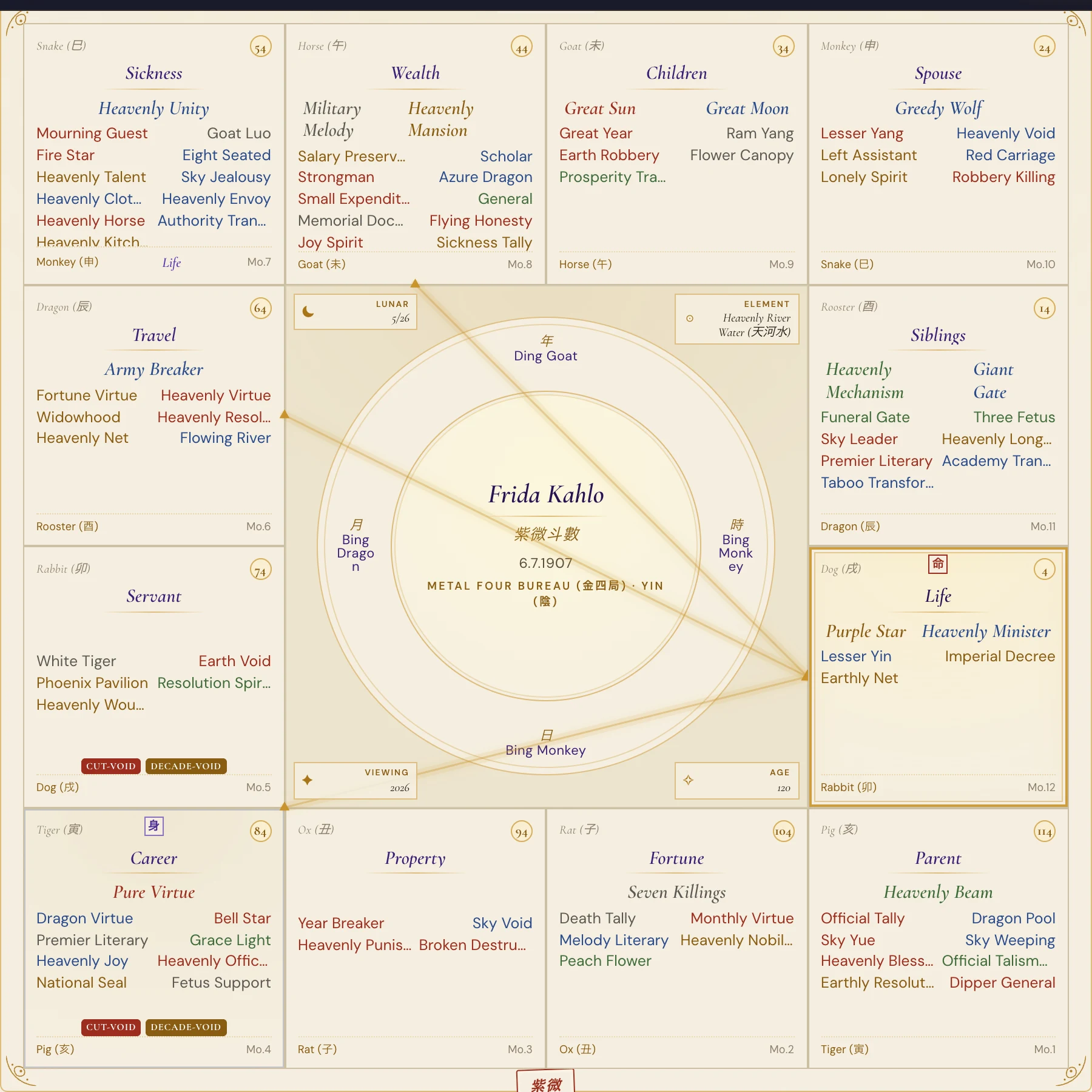
Frida's capacity to maintain dignity while confronting devastating physical trauma reflects the imperial nature of Purple Star in her Life Palace
Life Palace Palace 命宮 · Purple Star 紫微 · Celestial Minister 天相
Purple Star 紫微, the emperor among stars, grants its native an unshakeable sense of personal sovereignty that cannot be diminished by external circumstances. In Frida's case, this manifested as her ability to face over thirty surgeries, chronic pain, and eventual leg amputation with a dignity that awed observers. Rather than retreating into victimhood, she transformed her hospital bed into a studio, her pain into paintings, and her physical limitations into artistic liberation.
Celestial Minister 天相, the diplomatic advisor to the emperor, provided the refined aesthetic sensibility that allowed her to present her suffering as high art rather than mere complaint. This star's influence is evident in her meticulous attention to symbolism, color, and composition in works like 'The Broken Column' (1944), where she depicted her fractured spine with the precision of a medical illustration yet the emotional power of a religious icon. The combination of Purple Star's imperial bearing and Celestial Minister's artistic refinement enabled her to transform personal catastrophe into universal statements about the human condition.
The presence of Seven Killings in her Fortune Palace reveals the spiritual warrior who used suffering as fuel for transcendent creativity
Fortune Palace Palace 福德宮 · Seven Killings 七殺
Seven Killings 七殺 in the Fortune Palace 福德宮 creates a soul that finds spiritual fulfillment through confronting life's harshest challenges. This star's warrior energy explains why Frida never painted to escape her pain but rather to dive deeper into it, extracting meaning from every moment of suffering. Her famous declaration 'I paint my own reality' reflects Seven Killings' refusal to accept surface appearances, always probing for the deeper truth beneath.
This stellar influence manifested in her approach to both art and life as battles to be won through sheer force of will. When doctors told her she might never walk again, she painted herself dancing. When miscarriages shattered her dreams of motherhood, she created haunting works like 'Henry Ford Hospital' (1932) that transformed private grief into public art. Seven Killings drove her to find victory in defeat, turning every medical crisis into an opportunity to explore new depths of human experience through her brush.
Greedy Wolf in her Spouse Palace explains her passionate but tumultuous marriage to Diego Rivera
Spouse Palace Palace 夫妻宮 · Greedy Wolf 貪狼
Greedy Wolf 貪狼 in the Spouse Palace 夫妻宮 creates relationships characterized by intense passion, mutual fascination, and inevitable drama. This star perfectly describes Frida's legendary union with muralist Diego Rivera—a connection so powerful it survived divorce and remarriage, countless infidelities, and fundamental political disagreements. Greedy Wolf's influence explains why their relationship was simultaneously destructive and creatively fertilizing.
The star's appetite for experience manifested in both partners' extramarital affairs, including Rivera's devastating liaison with Frida's sister Cristina. Yet Greedy Wolf also brings the gift of endless renewal, which explains how their love survived betrayals that would destroy ordinary marriages. Their relationship became a work of art in itself—passionate, public, and ultimately transcendent. When they remarried in 1940, it was not despite their tumultuous history but because of it, recognizing that their creative and emotional symbiosis required exactly this kind of dramatic intensity.
Sun and Moon together in her Children Palace illuminate her complex relationship with creation and legacy
Children Palace Palace 子女宮 · Sun 太陽 · Moon 太陰
The conjunction of Sun 太陽 and Moon 太陰 in the Children Palace 子女宮 creates a profound duality regarding offspring and creative legacy. While Frida never had biological children due to her injuries and repeated miscarriages, these luminaries transformed her frustrated maternal energy into artistic fertility that has 'birthed' countless cultural movements and inspired millions worldwide.
The Sun's masculine creative force combined with the Moon's feminine nurturing energy explains why her paintings often depicted pregnancy, birth, and maternal imagery with such visceral power. Works like 'My Birth' (1932) and 'What the Water Gave Me' (1938) reveal an artist who channeled her thwarted biological creativity into artistic reproduction. The dual luminaries ensured that while her body could not sustain physical offspring, her spirit would generate an artistic legacy that continues to give birth to new interpretations, exhibitions, and cultural movements decades after her death.