The Evidence
Reading the Life Through the Chart
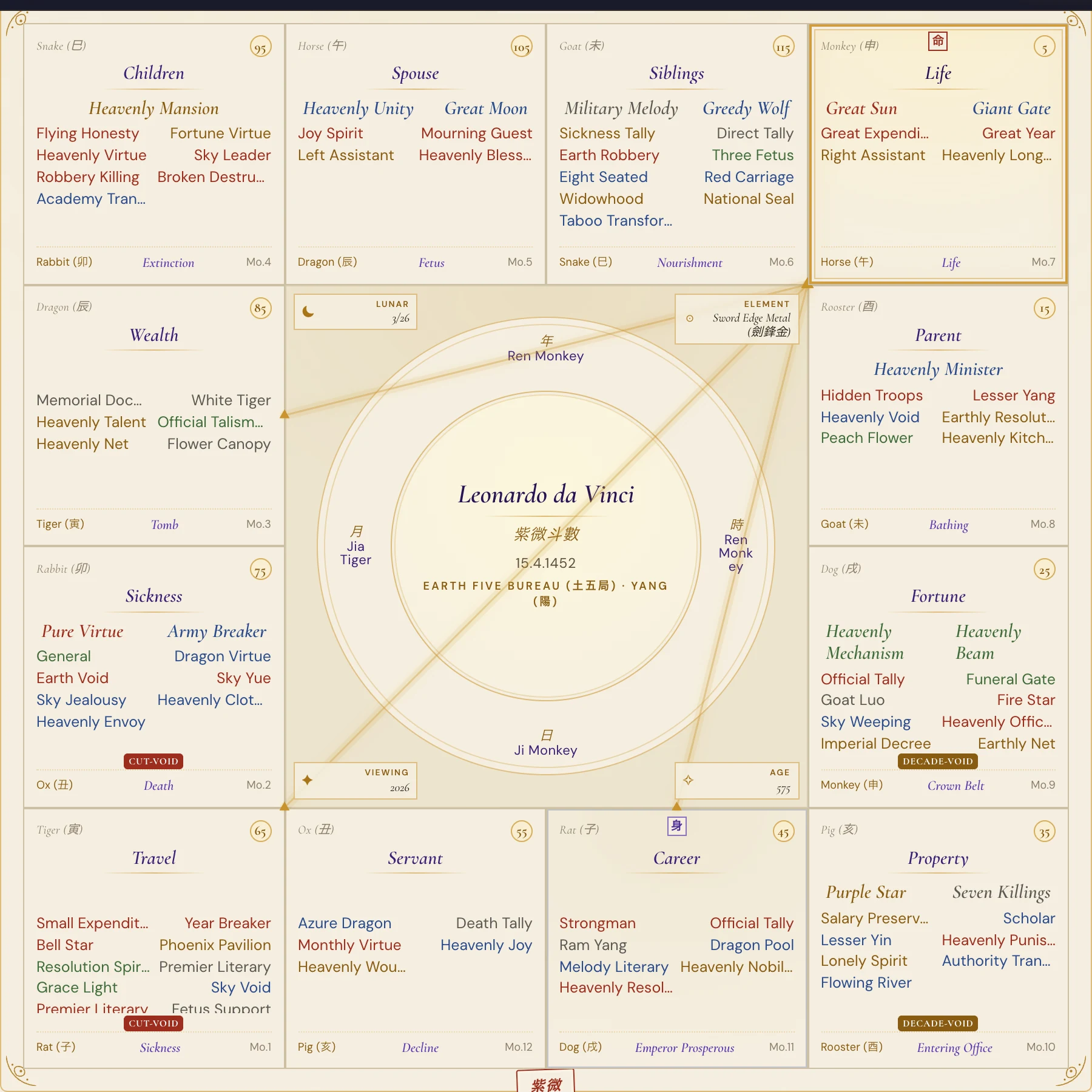
His Life Palace configuration explains Leonardo's unique fusion of artistic brilliance with scientific investigation
Life Palace 命宮 Palace 命宫 · Sun 太陽 · Giant Gate 巨門
The Sun 太陽 in Leonardo's Life Palace manifested as an almost solar radiance of creative authority that drew powerful patrons throughout his career—from Ludovico Sforza in Milan to King Francis I of France. The Sun's natural leadership and illuminating power expressed itself through his masterworks like The Last Supper and Mona Lisa, paintings that literally light up their spaces with revolutionary techniques of chiaroscuro and sfumato. Yet this was no mere artistic ego; the Sun's drive for prominence was tempered and focused by Giant Gate 巨門, the star of profound investigation and analytical communication.
Giant Gate 巨門's influence explains Leonardo's compulsive note-taking and his famous mirror writing—a secretive, investigative approach to recording his discoveries about anatomy, hydraulics, and mechanics. This star's energy drove him to dissect corpses in monastery basements, map the flow of water through landscapes, and design flying machines centuries before flight became reality. Where others saw a painter, Giant Gate revealed the scientist; where others saw an artist, it unveiled the engineer. The combination created a mind that could not rest with surface beauty but had to penetrate to the underlying principles.
The placement in Monkey 申 adds crucial dynamism to this configuration. The Monkey's quick intelligence and adaptability allowed Leonardo to master disciplines as diverse as military engineering, court entertainment, and anatomical illustration. This restless, clever energy explains his tendency to leave projects unfinished—not from laziness, but because his mind was already racing toward the next discovery. The Monkey's gift for imitation and improvement manifested in his ability to study existing techniques, then revolutionize them through deeper understanding of their principles.
His Body Palace in Career reveals how professional achievement became the primary vehicle for spiritual fulfillment
Career Palace 官祿宮 Palace 官禄宫 ·
With his Body Palace 身宮 positioned in the Career Palace 官祿宮, Leonardo's spiritual essence found expression through professional mastery rather than personal relationships or material accumulation. This placement explains why he never married or had children—his creative output became his legacy, his workshops and notebooks his most intimate relationships. The Body Palace represents one's true nature and deepest motivations, and its location in Career meant that Leonardo's soul literally lived through his work.
This configuration illuminates his pattern of seeking ever-more prestigious positions: from Verrocchio's workshop in Florence, to the Sforza court in Milan, to papal service in Rome, and finally to the French royal court. Each move represented not mere career advancement but spiritual evolution, as his Body Palace demanded increasingly sophisticated platforms for expression. His willingness to abandon unfinished works when better opportunities arose wasn't fickleness—it was the Body Palace's drive toward the highest possible manifestation of his gifts.
The Career Palace's empty major star condition (無正曜) is particularly significant here. Rather than being limited by a single star's nature, Leonardo's professional identity remained fluid and multifaceted. He could be painter, engineer, anatomist, inventor, or court entertainer as circumstances required. This emptiness became fullness, allowing him to synthesize influences from all other palaces and create entirely new categories of Renaissance achievement. His career became a mirror reflecting the full spectrum of human knowledge and creative possibility.
The Fortune Palace configuration reveals his philosophical approach to happiness through understanding nature's mysteries
Fortune Palace 福德宮 Palace 福德宫 · Celestial Mechanism 天機 · Celestial Beam 天梁
Celestial Mechanism 天機 in Leonardo's Fortune Palace explains his profound contentment with intellectual process over material results. This star governs wisdom, strategy, and the joy found in solving complex problems—perfectly matching his documented habit of pursuing scientific investigations for their own sake, often without concern for practical application or financial reward. His notebooks overflow with studies that brought him no immediate gain: detailed drawings of water flow, anatomical studies of hearts and lungs, geometric puzzles, and mechanical designs that wouldn't be buildable for centuries.
Celestial Beam 天梁's presence alongside Celestial Mechanism created a philosophical foundation for this investigative joy. Celestial Beam represents the elder's wisdom, the teacher's perspective, and the satisfaction found in preserving and transmitting knowledge. This explains Leonardo's meticulous documentation of his discoveries and his careful cultivation of pupils like Salaì and Francesco Melzi. His happiness came not from personal glory but from contributing to humanity's expanding understanding of natural law.
The Dog 戌 placement of this palace adds a loyal, protective quality to his relationship with knowledge. Like a faithful guardian, Leonardo protected the integrity of his observations, refusing to publish speculative theories without sufficient evidence. The Dog's honest, methodical nature explains his insistence on direct observation over received authority—dissecting actual corpses rather than trusting ancient texts, studying real water flows rather than accepting theoretical descriptions. This configuration made him happiest when serving as humanity's faithful investigator of truth.
His Property Palace combination explains his attraction to powerful patrons and courtly environments
Property Palace 田宅宮 Palace 田宅宫 · Purple Star 紫微 · Seven Killings 七殺
Purple Star 紫微 in Leonardo's Property Palace reveals his natural affinity for imperial settings and aristocratic patronage. This emperor star explains why he thrived in the courts of Milan, Rome, and France rather than in the merchant workshops of Florence. Purple Star demands dignified surroundings worthy of its cosmic authority, and Leonardo consistently sought positions that offered both material comfort and intellectual prestige. His moves from patron to patron weren't opportunistic but reflected Purple Star's need for environments that could properly house and honor his gifts.
Seven Killings 七殺 adds a revolutionary edge to this imperial energy. While Purple Star sought established authority, Seven Killings brought the warrior's spirit to transform and conquer new territories of knowledge. This combination explains Leonardo's ability to maintain independence even while serving powerful rulers—he was never merely a court functionary but always remained the master of his own intellectual domain. Seven Killings' pioneering nature drove him to establish entirely new fields: scientific illustration, mechanical engineering applied to art, anatomical accuracy in religious painting.
The Pig 亥 placement grounds these cosmic energies in practical wisdom and resource accumulation. The Pig's association with abundance and material security explains Leonardo's skill at negotiating favorable terms with patrons, ensuring not just payment but also provision of materials for his experiments. This wasn't mere materialism—the Property Palace's proper functioning was essential for his Life Palace's Sun 太陽 to shine fully. He needed workshops, assistants, access to libraries, and protection from mundane concerns to achieve his revolutionary synthesis of art and science.
The Health Palace reveals how his investigations into mortality shaped both his art and science
Health Palace 疾厄宮 Palace 疾厄宫 · Pure Virtue 廉貞 · Breaker of Armies 破軍
Pure Virtue 廉貞 in Leonardo's Health Palace manifested as an intense, almost obsessive relationship with physical mortality and the mysteries of the human body. This star's transformative fire energy drove his unprecedented anatomical studies, dissecting perhaps thirty corpses to understand the mechanics of life and death. Pure Virtue's penetrating nature explains his ability to see past social taboos around death and corpses—his notebooks contain detailed drawings of skulls, muscles, organs, and circulatory systems that reveal an unflinching fascination with mortality's realities.
Breaker of Armies 破軍 alongside Pure Virtue created a revolutionary approach to understanding health and disease. This destructive-creative star explains his willingness to literally break apart bodies to understand their construction, approaching anatomy like a military engineer studying fortifications. The combination produced his famous studies of the heart as a hydraulic pump, the eye as an optical instrument, and the brain as the seat of sensation—insights that wouldn't be fully validated until centuries later.
The Rabbit 卯 placement adds sensitivity and refinement to these intense energies. Rather than crude butchery, Leonardo's anatomical work displayed an artist's eye for beauty even in death, creating drawings of such aesthetic power that they remain masterpieces of scientific illustration. This placement also explains his documented vegetarianism and gentle treatment of animals—Pure Virtue and Breaker of Armies taught him to respect life precisely because he understood death so intimately. His art gained its profound humanity through this unflinching examination of human fragility.
His Siblings Palace configuration illuminates his complex relationship with collaboration and competition
Siblings Palace 兄弟宮 Palace 兄弟宫 · Military Music 武曲 · Greedy Wolf 貪狼
Military Music 武曲 in Leonardo's Siblings Palace explains his disciplined, almost martial approach to workshop management and his relationships with fellow artists. This metal star's precision and strategic thinking manifested in his careful cultivation of pupils like Salaì and Francesco Melzi, whom he trained with military thoroughness in both artistic techniques and scientific methods. Military Music's influence made him a demanding but effective teacher, expecting the same rigorous standards from students that he applied to his own work.
Greedy Wolf 貪狼's presence alongside Military Music reveals the competitive edge that drove his artistic innovations. This star's ambitious, acquisitive nature explains his rivalry with contemporaries like Michelangelo and his constant drive to master new disciplines. Greedy Wolf's versatility allowed him to absorb techniques from metalworking, engineering, and natural philosophy, then apply them to painting in ways that revolutionized the medium. The star's shape-shifting quality is reflected in his ability to work successfully with artists, scientists, and courtiers alike.
The Goat 未 placement adds artistic refinement and aesthetic sensitivity to these dynamic forces. The Goat's association with culture and beauty explains how Leonardo's competitive drive (Greedy Wolf) and disciplinary rigor (Military Music) always served higher artistic purposes. His workshop wasn't merely a business but a laboratory for aesthetic and technical innovation, where collaboration and competition combined to push the boundaries of what Renaissance art could achieve.