The Evidence
Reading the Life Through the Chart
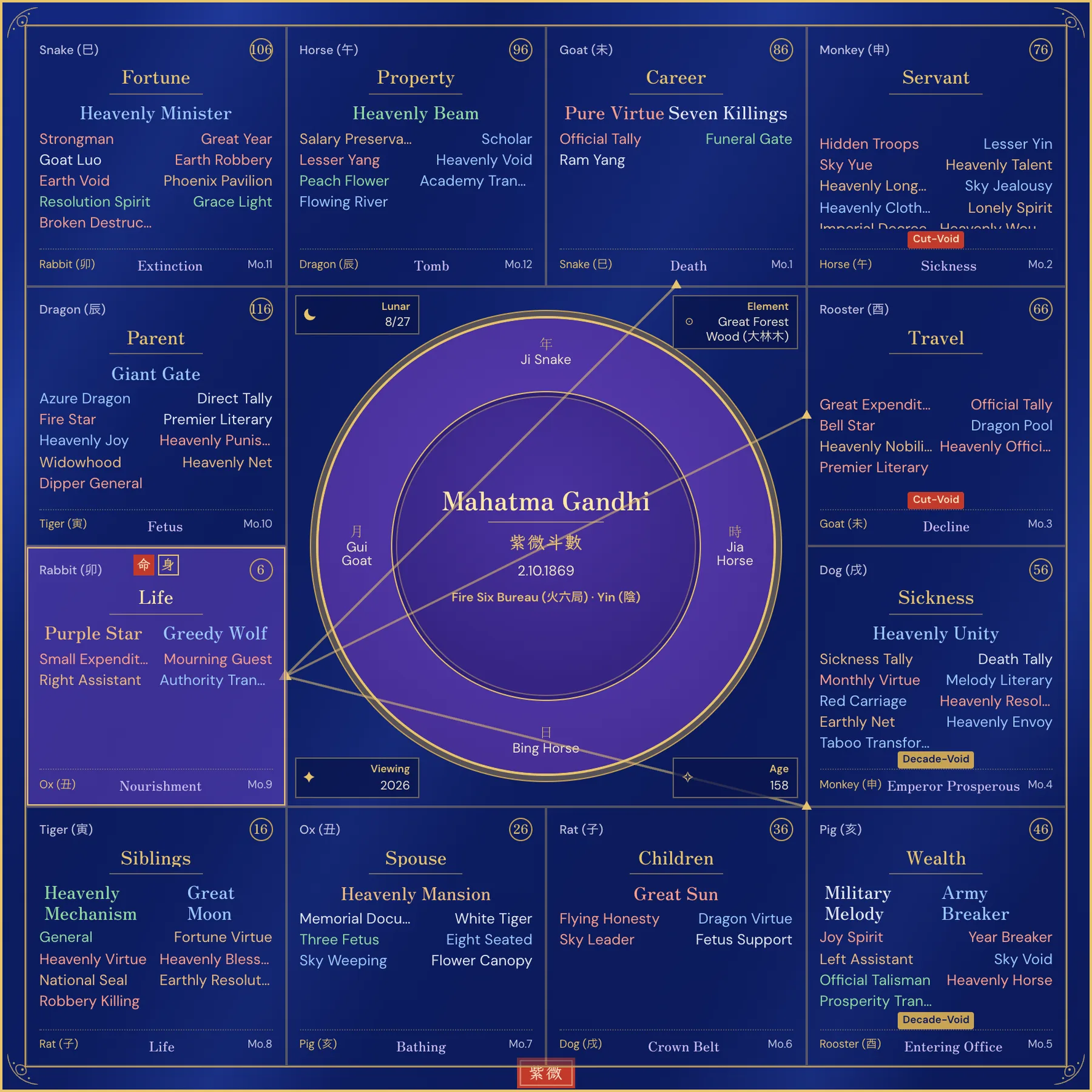
The Royal Revolutionary: Purple Star and Greedy Wolf in the Life Palace
Life Palace 命宮 Palace 命宮 · Purple Star 紫微 · Greedy Wolf 貪狼
Gandhi's Life Palace 命宮 contains the most paradoxical stellar combination in Zi Wei Dou Shu: Purple Star 紫微, the emperor star representing supreme authority, paired with Greedy Wolf 貪狼, the star of desire and transformation. This conjunction explains how a man born to privilege could revolutionary reinvent the very concept of power. Purple Star 紫微 gave Gandhi natural leadership and an instinctive understanding of sovereignty, but Greedy Wolf 貪狼 subverted these imperial qualities toward radical transformation.
The emperor star manifested not in seeking traditional power but in Gandhi's assumption of moral authority over the British Empire itself. When he declared "An unjust law is no law at all," he was speaking as Purple Star 紫微—not as a subject petitioning his rulers, but as a sovereign pronouncing judgment. His famous fasts were imperial edicts issued through self-denial: when Gandhi refused food, governments fell. The Salt March of 1930 epitomized this dynamic—a single man walking to the sea, challenging an empire's monopoly through the simple act of making salt.
Greedy Wolf 貪狼 transformed Gandhi's relationship with desire itself. Rather than pursuing conventional appetites for wealth, comfort, or status, this star redirected his enormous ambition toward spiritual and political revolution. His "experiments with truth" were Greedy Wolf's 貪狼 insatiable hunger channeled into moral innovation. The star's association with dramatic change explains Gandhi's ability to constantly reinvent his methods—from lawyer to activist to ascetic to independence leader—always driven by an almost greedy appetite for justice.
This stellar pairing also illuminates Gandhi's magnetic charisma. Purple Star 紫微 commanded natural respect, while Greedy Wolf 貪狼 generated the transformative energy that drew followers into his moral revolution. His ashrams became alternative kingdoms where he ruled not through force but through example, embodying the Purple Star's 紫微 sovereignty while Greedy Wolf's 貪狼 innovative spirit created new ways of living and resisting.
The Warrior-Sage: Military Music as Life Master
Life Master Palace 命主 · Military Music 武曲
Military Music 武曲 as Gandhi's Life Master reveals the martial essence beneath his nonviolent exterior. This star governs warfare, but Gandhi revolutionized its expression—instead of external battle, he turned Military Music's 武曲 warrior energy inward, fighting against injustice through disciplined self-conquest. His daily routine resembled military discipline: rising at 4 AM, precise schedules, rigorous physical exercise, and unwavering adherence to vows that would break lesser men.
The star's association with metal and sharpness manifested in Gandhi's cutting moral precision. Military Music 武曲 gave him the ability to slice through complex political situations with simple, devastating truth. "Be the change you wish to see in the world" was not gentle philosophy but sharp tactical doctrine—Military Music 武曲 recognizing that the most effective weapon against oppression was personal transformation. His fasts were military campaigns conducted on the battlefield of his own body.
Military Music's 武曲 strategic genius appears throughout Gandhi's campaigns. The Salt March exemplified military thinking: choosing terrain (the sea, universal and symbolic), timing (peak political tension), and tactics (civil disobedience) that made British response impossible without moral defeat. His "army" of satyagrahis trained like soldiers, disciplined in nonviolent resistance, ready to face imprisonment and beating without retaliation. This was Military Music 武曲 commanding troops through moral rather than physical force.
The star's connection to justice and righteousness explains Gandhi's uncompromising stance on principles. Military Music 武曲 tolerates no deviation from duty—hence Gandhi's willingness to call off mass movements when they turned violent, even at enormous political cost. His assassination ironically fulfilled Military Music's 武曲 warrior destiny: he died in service to his cause, a general fallen on the battlefield of communal harmony.
The Wealth Renouncer: Military Music and Breaker of Armies in the Wealth Palace
Wealth Palace 財帛宮 Palace 財帛宮 · Military Music 武曲 · Breaker of Armies 破軍
Gandhi's Wealth Palace 財帛宮 contains Military Music 武曲 and Breaker of Armies 破軍, a combination that destroyed conventional relationships with money and material possessions. Military Music 武曲 in the wealth sector typically indicates earning through service or government, which Gandhi initially fulfilled as a successful lawyer in South Africa. However, Breaker of Armies 破軍 shattered this trajectory, compelling him to abandon lucrative practice for the uncertain path of political activism.
The presence of Breaker of Armies 破軍 in wealth matters explains Gandhi's radical economic philosophy. This star demolishes existing structures to create space for new growth, which Gandhi embodied through his systematic destruction of personal wealth accumulation. His adoption of khadi (hand-spun cloth) wasn't mere symbolism but economic warfare—Breaker of Armies 破軍 attacking the British textile industry through the revolutionary act of spinning his own clothes. He transformed poverty from deprivation into political weapon.
Military Music 武曲 brought discipline to Gandhi's relationship with money, but filtered through Breaker of Armies' 破軍 destructive lens, this became rigorous non-accumulation. His ashrams operated on principles that would horrify economists—no private property, shared resources, voluntary labor. Yet this apparent economic madness proved strategically brilliant, removing British leverage over the independence movement. How do you bribe or intimidate a leader who owns nothing?
The stellar combination also reveals Gandhi's understanding that true wealth meant freedom from material dependency. Breaker of Armies 破軍 destroyed his attachment to conventional success, while Military Music 武曲 provided the iron discipline necessary to maintain voluntary poverty. His economic philosophy—that everyone should produce what they consume—was Breaker of Armies 破軍 demolishing industrial capitalism while Military Music 武曲 enforced the austere discipline required for self-sufficiency.
The Career Revolutionary: Pure Virtue and Seven Killings in the Career Palace
Career Palace 官祿宮 Palace 官祿宮 · Pure Virtue 廉貞 · Seven Killings 七殺
Gandhi's Career Palace 官祿宮 houses Pure Virtue 廉貞 and Seven Killings 七殺, explaining how he transformed the legal profession into moral revolution. Pure Virtue 廉貞, associated with integrity and correct relationships, gave him natural understanding of justice and law. However, Seven Killings 七殺, the star of solitary struggle and dramatic change, prevented him from following conventional legal career paths, driving him toward increasingly radical forms of advocacy.
Seven Killings 七殺 manifests through careers that challenge existing power structures, which perfectly describes Gandhi's trajectory from obedient barrister to imperial nemesis. This star operates alone, explaining Gandhi's willingness to break from established nationalist leaders when they advocated violence or compromise. His most effective campaigns—the Salt March, Quit India Movement—were essentially Seven Killings 七殺 strategies: dramatic, solitary leadership that forced fundamental change through moral confrontation.
Pure Virtue 廉貞 in the career sector ensured that Gandhi's professional life centered on ethical relationships and social harmony. His legal training served not personal advancement but collective liberation, transforming courtroom advocacy into political theater. The star's association with correct social bonds explains his focus on Hindu-Muslim unity and untouchable rights—Pure Virtue 廉貞 recognizing that true career success meant healing society's fundamental relationships.
The combination of these stars created a career pattern unique in political history: Pure Virtue's 廉貞 ethical foundation enabled Seven Killings' 七殺 revolutionary methods to maintain moral authority. Where other revolutionaries might use violence or deception, Gandhi's career remained anchored in Pure Virtue's 廉貞 commitment to truth and right relationship. Seven Killings 七殺 provided the dramatic flair and willingness to stand alone, while Pure Virtue 廉貞 ensured that his solitary stands served collective good rather than personal ambition.
The Bodily Vessel: Celestial Unity in the Health Palace
Health Palace 疾厄宮 Palace 疾厄宮 · Celestial Unity 天同
Celestial Unity 天同 in Gandhi's Health Palace 疾厄宮 reveals how his physical body became both political instrument and spiritual battlefield. This star represents harmony, peace, and childlike innocence, suggesting that Gandhi's health challenges served higher purposes of unity and reconciliation. His famous fasts weren't mere political theater but Celestial Unity 天同 using physical suffering to restore social harmony—his weakened body becoming a vessel for collective healing.
The star's association with water and flowing energy explains Gandhi's ability to endure extreme physical hardship while maintaining inner serenity. Celestial Unity 天同 gave him almost supernatural resilience during imprisonment, allowing him to emerge from brutal jail conditions with spirit intact. His minimal diet and ascetic practices weren't self-punishment but Celestial Unity's 天同 natural tendency toward simplicity and contentment with little.
Celestial Unity 天同 also manifests through Gandhi's use of his body as communication medium. His spinning wheel, walking stick, and simple dress became iconic precisely because Celestial Unity 天同 in health matters made his physical presence inherently peaceful and unifying. People felt calmed by his appearance, sensing the star's harmonizing influence even in tense political situations. His assassination attempts (successful and otherwise) targeted not just a leader but Celestial Unity's 天同 embodied promise of peace.
The star's childlike quality explains Gandhi's experimental approach to health and diet. Celestial Unity 天同 maintains curiosity and openness throughout life, which Gandhi expressed through constant experimentation with food, exercise, and medical treatments. His "experiments with truth" extended to physical health, treating his body as laboratory for discovering optimal human functioning—Celestial Unity 天同 seeking harmony between spirit and flesh that could model possibility for humanity.