The Evidence
Reading the Life Through the Chart
The Life Palace reveals why Napoleon was born to rule absolutely
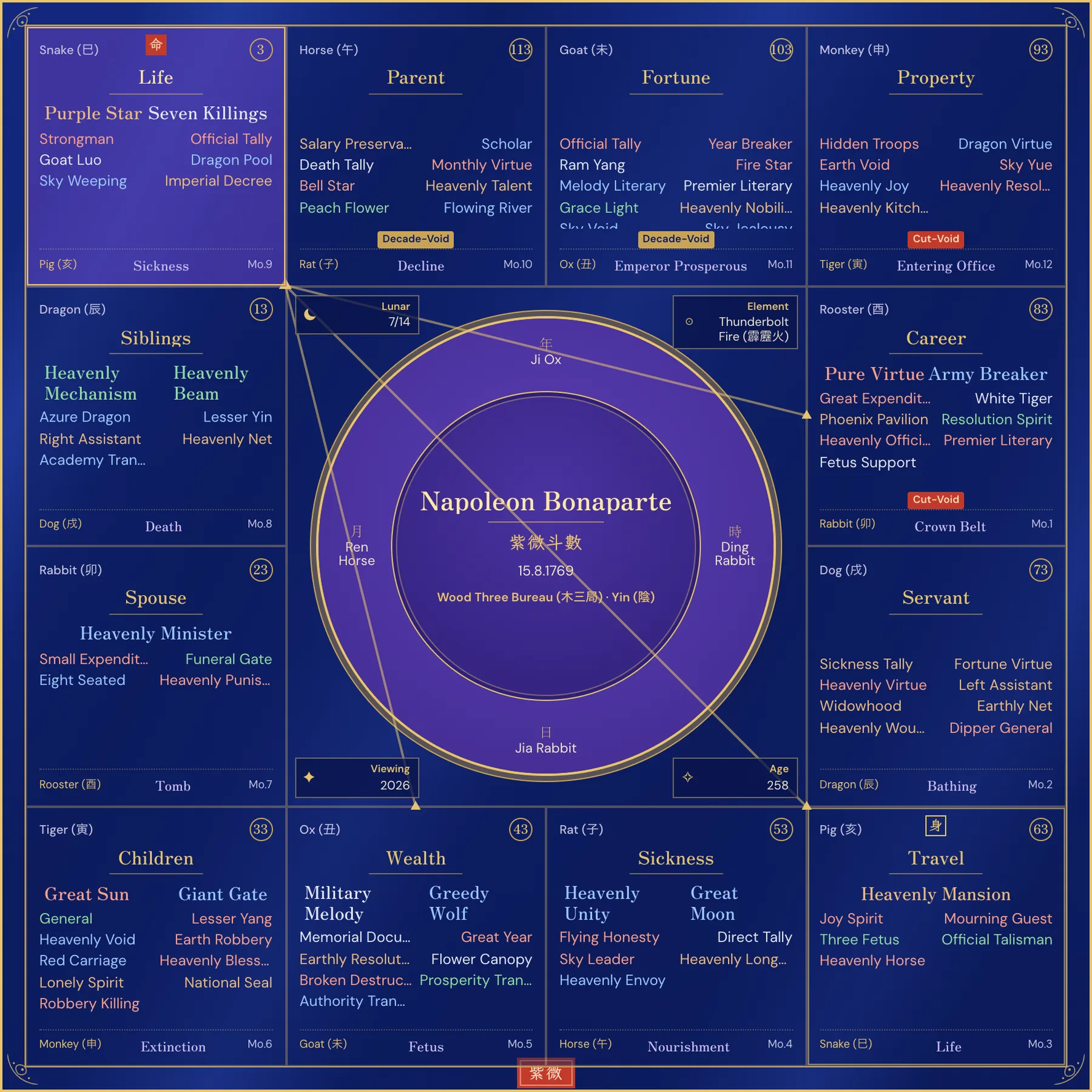
Life Palace Palace 命宮 · Purple Star 紫微 · Seven Killings 七殺
Purple Star 紫微, the supreme imperial star, sitting in Napoleon's Life Palace 命宮 marks him as destined for sovereignty. This is not metaphor—it is cosmic fact encoded in his birth moment. Purple Star creates natural rulers who cannot accept subordination, individuals whose very existence demands the highest throne. When Napoleon crowned himself Emperor in 1804, grasping the crown from Pope Pius VII's hands to place it on his own head, he was merely fulfilling what his stars had decreed thirty-five years earlier.
Yet Purple Star does not rule alone in his chart. Seven Killings 七殺, the star of military conquest and ruthless action, transforms his imperial nature into something far more dangerous. Seven Killings brings the sword to Purple Star's scepter, creating not merely a king but a conqueror. This combination explains why Napoleon could never be content with ruling France—he required all of Europe. His wars were not political choices but cosmic compulsions, driven by stars that demanded he prove his supremacy through battle. The retreat from Moscow in 1812 and defeat at Waterloo in 1815 came not from strategic errors but from the inevitable exhaustion of even celestial energies when pushed beyond their limits.
The Wood Three Cycle 木三局 governing his chart adds the element of growth and expansion to this imperial configuration. Like a tree that must grow or die, Napoleon's empire could never remain static. Each victory demanded another, each throne conquered required the next to be seized. His Life Palace stars created not just an emperor but an emperor who must perpetually expand his dominion until the very cosmos conspired to stop him.
His Body Palace explains the compulsion to seek empire far from home
Travel Palace (Body Palace) Palace 遷移宮 (身宮) · Celestial Treasury 天府
Napoleon's Body Palace 身宮 residing in the Travel Palace 遷移宮 reveals the deepest truth about his character: he was destined to find his true self far from his birthplace. The Body Palace represents where one's spirit truly lives, and its placement in Travel means Napoleon could only fulfill his nature through constant movement and foreign conquest. This explains why he could never remain content in Corsica, Paris, or any single location—his essential being required the endless horizons of campaign and conquest.
Celestial Treasury 天府 in this position adds profound significance to his wandering nature. Celestial Treasury is the star of accumulation and material success, but placed in the Travel Palace, it transforms foreign lands into the source of his wealth and power. Every nation Napoleon conquered became another vault in his celestial treasury. Italy, Austria, Prussia, Spain—each campaign was not merely military adventure but cosmic collection, gathering the riches and territories that his stars promised lay beyond Corsica's shores.
This placement also explains his ultimate fate. When his Body Palace stars were finally blocked by superior forces—the coalitions of 1814 and 1815—he could no longer access foreign lands to replenish his spiritual and material treasury. Exile to St. Helena represented the cruelest possible punishment for one whose Body Palace demanded perpetual movement: confinement to a tiny island where his Travel Palace stars could no longer function. His death in 1821 was not merely physical deterioration but the cosmic consequence of severing a soul from its destined element of movement and expansion.
His Career Palace shows why traditional governance could never contain him
Career Palace Palace 官祿宮 · Pure Virtue 廉貞 · Breaker of Armies 破軍
Pure Virtue 廉貞 and Breaker of Armies 破軍 in Napoleon's Career Palace 官祿宮 reveal why he could never be a conventional ruler but was instead destined to revolutionize everything he touched. Pure Virtue represents the highest principles and moral authority, while Breaker of Armies brings the power to destroy existing structures completely. Together, they created a leader who would tear down the old order to build something entirely new.
This combination manifested most clearly in his transformation from artillery officer to First Consul to Emperor. Each promotion required him to break the existing system—first the monarchy, then the Directory, finally the Republic itself. The Napoleonic Code, his greatest legislative achievement, exemplifies Pure Virtue's influence: a legal system based on merit and rational principles rather than aristocratic privilege. Yet this same work required Breaker of Armies to destroy centuries of feudal law and custom. His career was perpetual revolution disguised as governance.
The tension between these stars explains why Napoleon could never establish a stable dynasty. Pure Virtue demanded he create something worthy and enduring, but Breaker of Armies compelled him to keep destroying and rebuilding. His empire became a magnificent but temporary structure, constantly being torn down and reconstructed according to military necessities. When the Hundred Days ended at Waterloo, it was these Career Palace stars finally exhausting themselves—Pure Virtue's vision and Breaker of Armies' destructive power having consumed each other in the attempt to maintain an inherently unsustainable system.
The Siblings Palace reveals the family bonds that both elevated and constrained him
Siblings Palace Palace 兄弟宮 · Celestial Mechanism 天機 · Celestial Beam 天梁
Celestial Mechanism 天機 and Celestial Beam 天梁 in Napoleon's Siblings Palace 兄弟宮 illuminate his complex relationship with his seven brothers and sisters, bonds that would shape European politics for a generation. Celestial Mechanism brings intelligence and strategic thinking to family relationships, while Celestial Beam represents protection and authority within the clan. Together, they created a Bonaparte dynasty built on mutual advancement and shared ambition.
Napoleon's systematic placement of his siblings on European thrones demonstrates Celestial Mechanism's influence. Joseph became King of Spain, Louis ruled Holland, Jérôme took Westphalia, while sisters Elisa, Pauline, and Caroline received duchies and principalities. This was not mere nepotism but strategic family deployment, using blood bonds to secure his empire. Each appointment reflected Celestial Mechanism's ability to calculate how family ties could serve larger purposes. The Bonapartes became Europe's first modern political dynasty, bound together by stars that made family loyalty inseparable from imperial strategy.
Yet Celestial Beam's protective influence also created Napoleon's greatest vulnerability. His determination to shield and elevate his relatives often conflicted with sound governance. Louis's resistance to French economic policies in Holland, Joseph's military incompetence in Spain, Lucien's political opposition—these family conflicts weakened the empire because Napoleon could never fully discipline those his Siblings Palace stars commanded him to protect. The irony is profound: the same celestial configuration that helped him build a continental empire also ensured its instability, as family loyalty repeatedly trumped imperial necessity in his calculations.