The Evidence
Reading the Life Through the Chart
Tesla's imperial intellect was both his greatest gift and his fatal flaw
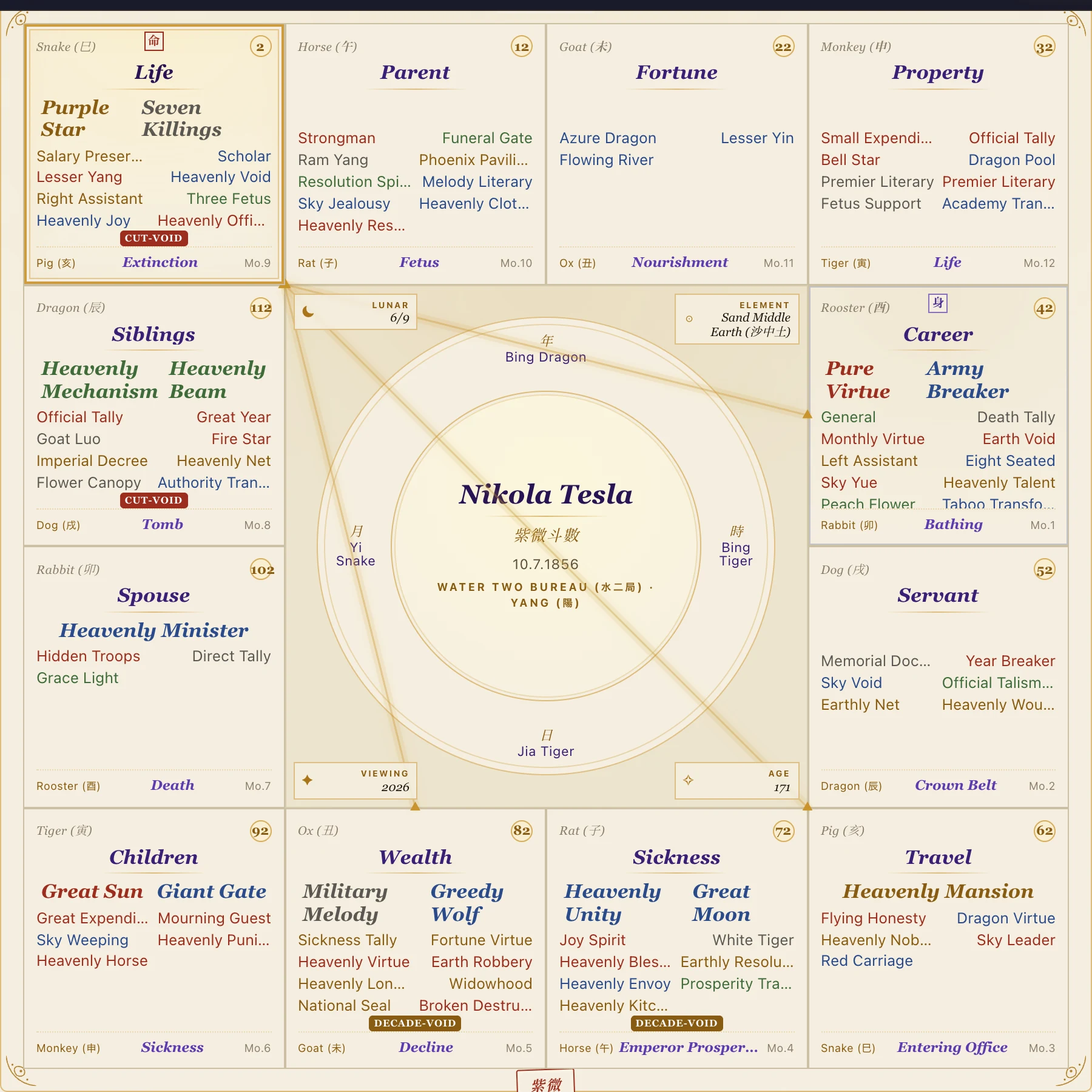
Life Palace Palace 命宮 · Purple Star 紫微 · Seven Killings 七殺
The presence of Purple Star 紫微 in Tesla's Life Palace 命宮 marks him as a natural emperor of his domain—electrical engineering. Purple Star bestows supreme intellectual authority and the ability to perceive universal principles that escape ordinary minds. Tesla's famous capacity to build and test entire machines mentally before physical construction exemplifies this star's gift of comprehensive visualization. His AC motor and polyphase system didn't emerge from trial and error but from pure theoretical insight, much like an emperor issues decrees that transform entire kingdoms.
Yet Seven Killings 七殺 in the same palace reveals the shadow side of this imperial nature. This military star creates a compulsive need to fight, to stand alone against all opposition. Tesla's professional relationships consistently followed this pattern—initial collaboration followed by inevitable conflict and separation. His break with Edison over AC versus DC became personal warfare. His partnership with Westinghouse, though initially successful, eventually soured as Tesla's demands grew more extreme. Even his relationship with financier J.P. Morgan collapsed when Tesla's wireless transmission experiments at Wardenclyffe exceeded all reasonable bounds.
Seven Killings also manifests as self-sabotage disguised as principle. Tesla repeatedly destroyed his own commercial prospects by refusing to compromise his vision for practical gain. He tore up potentially lucrative contracts, abandoned profitable partnerships, and insisted on pursuing increasingly impractical experiments. Where Purple Star granted him the mind of a genius, Seven Killings ensured he would remain forever at war with the world that might have supported him.
His relationship with wealth revealed a fundamental incompatibility with material success
Wealth Palace Palace 財帛宮 · Military Music 武曲 · Greedy Wolf 貪狼
Military Music 武曲 in Tesla's Wealth Palace 財帛宮 creates a paradox that defined his entire financial trajectory. This star represents money earned through skill, discipline, and technical mastery—Tesla possessed all these qualities in abundance. His AC patents should have made him one of the wealthiest men in America, and indeed, his 1888 licensing deal with Westinghouse initially provided substantial income. Military Music rewards those who approach wealth with the same methodical precision they bring to their craft.
However, Greedy Wolf 貪狼 in the same palace reveals why Tesla's relationship with money remained perpetually unstable. Greedy Wolf creates intense desires that shift rapidly from one object to another—Tesla's pattern of abandoning profitable ventures for more exciting experiments perfectly embodies this star's restless energy. When J.P. Morgan initially funded Wardenclyffe Tower for wireless telegraphy, Tesla secretly expanded the project to include wireless power transmission without informing his backer. This exemplifies Greedy Wolf's tendency to pursue ever-more-grandiose schemes.
The combination of Military Music and Greedy Wolf also explains Tesla's peculiar generosity and financial naivety. Military Music can create almost noble indifference to personal enrichment when focused on higher purposes, while Greedy Wolf generates impulsive decisions about money. Tesla's reported gesture of tearing up his Westinghouse royalty agreement during the company's financial crisis demonstrates both stars working together—the disciplined engineer sacrificing personal gain, while the restless dreamer moves on to the next fascinating project. His death in poverty, despite holding over 300 patents, represents the ultimate expression of this stellar combination.
His celibacy and isolation stemmed from an inability to sustain intimate partnerships
Spouse Palace Palace 夫妻宮 · Celestial Minister 天相
Celestial Minister 天相 in Tesla's Spouse Palace 夫妻宮 reveals why he never married despite numerous reported admirers and social opportunities. This star represents the helpful advisor, the loyal minister who serves a greater cause—Tesla approached all relationships from this perspective, unable to conceive of true partnership between equals. He expected others to support his mission while he remained focused on his work, creating a fundamentally unbalanced dynamic unsuitable for marriage.
Celestial Minister also manifests as excessive concern for propriety and social presentation. Tesla's famous fastidiousness about personal appearance, his precise daily routines, and his horror of disorder all reflect this star's need for perfect social facade. Yet this same quality made intimate relationships impossible—he could not tolerate the natural messiness and unpredictability that genuine closeness requires. His relationships with women remained formal and distant, more like courtly admiration than romantic connection.
The isolation that characterized Tesla's later years represents Celestial Minister's shadow expression. When this star lacks a worthy master to serve, it becomes empty ceremony and meaningless ritual. Tesla's obsession with feeding pigeons in his final decades, his rigid hotel routines, and his increasingly bizarre pronouncements about death rays and Martian communication all reflect Celestial Minister's desperate attempt to maintain purpose and structure in an increasingly disconnected life. His celibacy was not the noble sacrifice he claimed but the inevitable result of stellar influences that made true intimacy impossible.
His career embodied the eternal struggle between innovation and destruction
Career Palace Palace 官祿宮 · Pure Virtue 廉貞 · Breaker of Armies 破軍
Pure Virtue 廉貞 in Tesla's Career Palace 官祿宮 manifests as both moral authority and emotional volatility in his professional life. This star demands absolute ethical standards and revolutionary transformation—Tesla's entire career was driven by the conviction that his electrical innovations would benefit humanity. His presentation at the 1893 Chicago World's Fair, where he demonstrated wireless lighting and electrical phenomena to amazed crowds, exemplifies Pure Virtue's missionary zeal. He genuinely believed his work would eliminate scarcity and suffering through unlimited wireless power.
Breaker of Armies 破軍 in the same palace reveals why Tesla's career followed a pattern of dramatic upheaval and reconstruction. This star tears down existing structures to build something entirely new—Tesla's AC system didn't simply compete with Edison's DC current but fundamentally transformed how electricity could be generated, transmitted, and used. Each major phase of his career involved destroying previous assumptions: his induction motor revolutionized manufacturing, his high-frequency experiments opened new fields of research, and his wireless transmission theories anticipated modern telecommunications.
Yet Breaker of Armies also explains why Tesla's later career descended into increasing isolation and failure. This star's destructive energy eventually turns inward when external transformation becomes impossible. Tesla's abandonment of practical engineering for increasingly theoretical and grandiose schemes—wireless power transmission, weather control, death rays—represents Breaker of Armies consuming its own achievements. His final decades, spent alone in hotel rooms working on projects that existed only in his mind, show Pure Virtue's moral mission corrupted by Breaker of Armies' relentless need to tear down and rebuild, even when reconstruction was no longer possible.
His visionary experiments reflected a mind unmoored from earthly constraints
Travel Palace Palace 遷移宮 · Celestial Treasury 天府
Celestial Treasury 天府 in Tesla's Travel Palace 遷移宮 reveals why his most famous achievements occurred far from his birthplace and why his ideas consistently transcended conventional boundaries. This star represents vast accumulation and storage—Tesla's mind functioned like a cosmic treasury, collecting and synthesizing electrical phenomena that others couldn't perceive. His Colorado Springs experiments in 1899-1900, where he claimed to receive signals from Mars and demonstrated wireless transmission across vast distances, exemplify Celestial Treasury's ability to work with forces beyond ordinary comprehension.
Celestial Treasury also manifests as the need for grand, palatial settings for one's true work. Tesla could never be satisfied with ordinary laboratory conditions—he required the dramatic landscape of Colorado Springs, with its natural electrical activity and vast open spaces, to pursue his most ambitious experiments. His Wardenclyffe Tower project represented the ultimate expression of this stellar influence: a palatial facility designed to transmit power and communication worldwide, befitting the cosmic scope of his vision.
Yet this same star explains why Tesla's later experiments became increasingly disconnected from practical reality. Celestial Treasury can become hoarding for its own sake, accumulating knowledge and theories without purpose. Tesla's final decades of theoretical work on particle beams, anti-gravity devices, and interplanetary communication represent Celestial Treasury's shadow expression—vast accumulation of ideas that could never be implemented or verified. His famous claim to have developed a 'death ray' that could destroy aircraft reflects this star's tendency toward grandiose schemes that exist more in imagination than reality.