The Evidence
Reading the Life Through the Chart
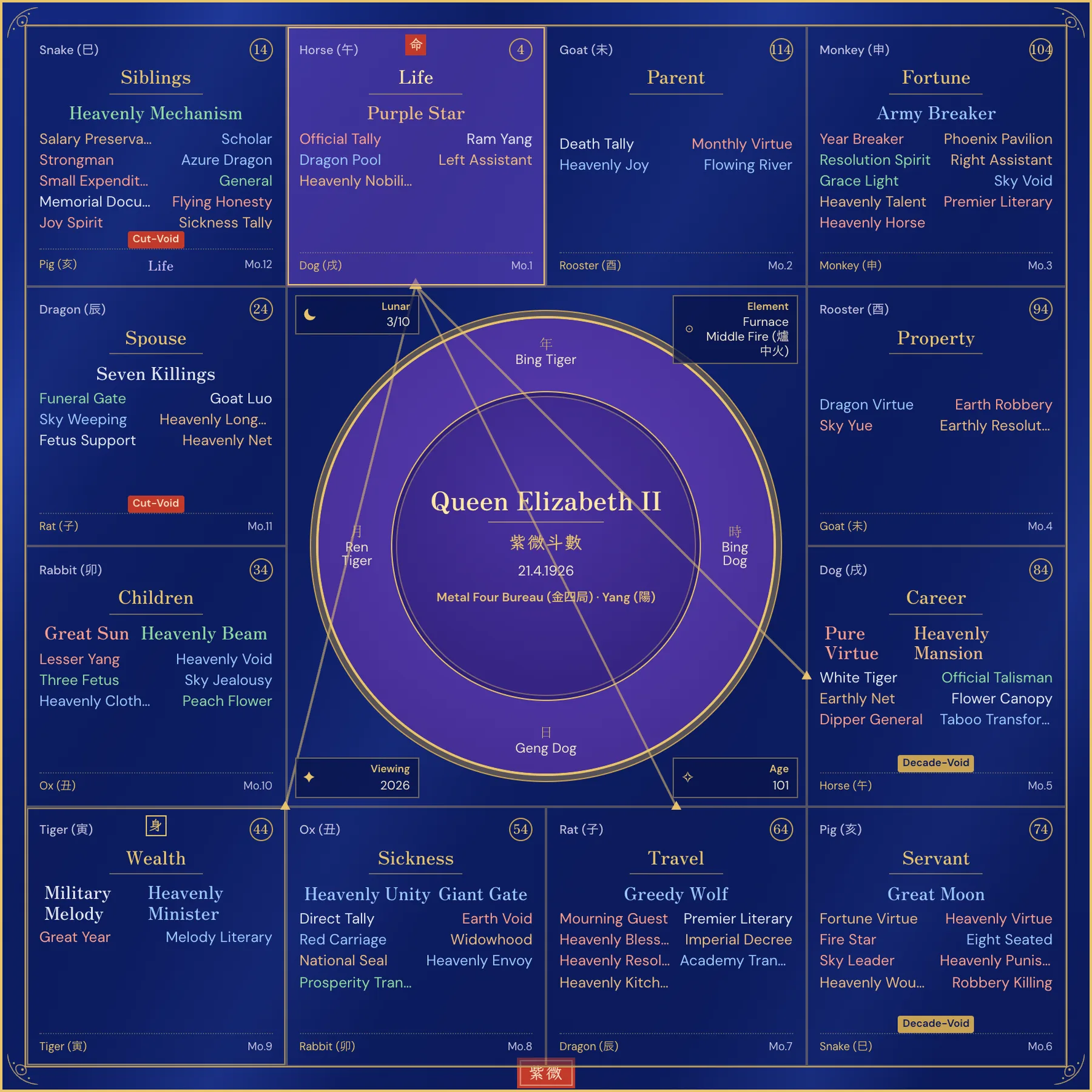
The Purple Star 紫微 in Elizabeth's Life Palace 命宮 reveals why she embodied sovereign authority with such natural command
Life Palace 命宮 Palace 命宮 · Purple Star 紫微
Purple Star 紫微, the emperor star, occupies Elizabeth's Life Palace 命宫 in the Horse 午 position—a placement that traditionally signifies absolute authority and natural leadership. This celestial configuration manifested throughout her life as an intuitive understanding of sovereign power that transcended formal training. Even as a child, observers noted her grave composure and instinctive grasp of protocol. When thrust into succession at ten, she didn't rebel against the burden but absorbed it with preternatural calm.
The Purple Star's influence became unmistakable during her accession in 1952. While in Kenya, receiving news of her father's death, she demonstrated the emperor star's characteristic ability to assume command without hesitation. Courtiers reported that she immediately began making decisions about the funeral arrangements and her coronation, displaying an authority that seemed to emerge from within rather than from constitutional instruction. Throughout her reign, this innate sovereignty allowed her to work with fifteen prime ministers while never appearing diminished by any of them—the Purple Star ensuring she remained the fixed point around which British political life revolved.
Perhaps most remarkably, Elizabeth's Purple Star manifested as what observers called her 'constitutional instincts'—an almost supernatural ability to know when to speak and when to remain silent. During the 1992 'annus horribilis,' the Diana crisis of 1997, and countless political upheavals, she navigated each challenge by embodying rather than asserting her authority. The emperor star in her Life Palace didn't make her imperious; it made her inevitable, a quality that sustained the monarchy through seven decades of change that might have toppled a lesser sovereign.
Seven Killings 七殺 in her Spouse Palace 夫妻宮 explains both the strength and sacrifice of her 73-year marriage to Prince Philip
Spouse Palace 夫妻宮 Palace 夫妻宮 · Seven Killings 七殺
Seven Killings 七殺 in Elizabeth's Spouse Palace 夫妻宮 positioned in Dragon 辰 reveals why her marriage required such extraordinary personal sacrifice while becoming the foundation of her reign. This martial star traditionally indicates a spouse relationship marked by strength, independence, and the willingness to subordinate personal desires for greater purpose. Prince Philip's entire adult life exemplified these themes—a Greek prince who surrendered his naval career, his surname, and his own ambitions to support his wife's constitutional role.
The Seven Killings influence became evident immediately after their 1947 marriage. Philip had to abandon his promising naval career when Elizabeth became queen in 1952, a sacrifice that the martial star demanded but that he accepted with characteristic directness. For decades, he walked two steps behind his wife in public, never expressing political opinions despite his strong views, channeling his warrior energy into supporting her reign rather than pursuing his own interests. This wasn't submission but strategic alliance—the Seven Killings star ensuring their marriage served the crown's survival.
Most poignantly, the martial star's influence shaped their private relationship in ways that only became apparent after Philip's death in 2021. Courtiers revealed that he had been her closest advisor and fiercest protector, the one person who could speak to her with complete honesty. Their 73-year marriage succeeded precisely because Seven Killings brought the warrior's discipline to their partnership—both understood that personal happiness was secondary to duty, but that understanding paradoxically created a bond stronger than conventional romance. When Philip died, Elizabeth lost not just her husband but her strategist, the martial star's energy that had sustained her through seven decades of reign.
Military Music 武曲 and Celestial Minister 天相 in her Body Palace 身宮 reveal the financial acumen that modernized royal wealth
Wealth Palace 財帛宮 Palace 財帛宮 · Military Music 武曲 · Celestial Minister 天相
The combination of Military Music 武曲 and Celestial Minister 天相 in Elizabeth's Wealth Palace 財帛宮, which doubles as her Body Palace 身宮 in Tiger 寅, reveals her remarkable but rarely discussed financial intelligence. Military Music traditionally governs strategic resource management, while Celestial Minister indicates diplomatic skill in financial matters—a combination that manifested as Elizabeth's ability to modernize royal finances while maintaining traditional appearances.
This stellar influence became crucial during the 1990s financial pressures on the monarchy. Facing criticism over tax exemptions and the cost of royal maintenance, Elizabeth negotiated the arrangement where she would pay income tax and capital gains tax on private income—a decision that required both Military Music's strategic thinking and Celestial Minister's diplomatic finesse. She understood that financial transparency was essential for monarchy's survival, even though it meant surrendering centuries-old privileges.
The Military Music and Celestial Minister combination also governed her private investment strategy, which transformed her personal wealth from an estimated £2 million at accession to over £370 million by 2022. Court sources suggest she took active interest in the Duchy of Lancaster's management and made shrewd decisions about art acquisitions that proved financially prescient. This wasn't mere accumulation but strategic thinking—the stars ensuring she built financial independence that protected the monarchy from political pressures while never appearing grasping or commercial. Her wealth became a tool of constitutional stability rather than personal luxury.
Sun 太陽 and Celestial Beam 天梁 in her Children Palace 子女宮 illuminate why her family relationships carried such constitutional weight
Children Palace 子女宮 Palace 子女宮 · Sun 太陽 · Celestial Beam 天梁
The pairing of Sun 太陽 and Celestial Beam 天梁 in Elizabeth's Children Palace 子女宮 in Rabbit 卯 reveals why her relationships with her four children became matters of constitutional significance rather than merely personal concern. The Sun traditionally represents authority and public visibility, while Celestial Beam signifies wisdom through experience and protective guidance—a combination that made her children's lives inseparable from the monarchy's reputation.
This stellar influence manifested most dramatically during the 'annus horribilis' of 1992, when three of her four children experienced marital breakdowns that became international news. The Sun's presence ensured that Prince Charles's separation from Diana, Princess Anne's divorce, and Prince Andrew's separation from Sarah Ferguson weren't private family matters but constitutional crises requiring Elizabeth's direct intervention. The Celestial Beam aspect prompted her protective instincts—she worked behind the scenes to minimize damage while publicly maintaining dignified silence about family turmoil.
The Children Palace stars also explain Elizabeth's complex relationship with succession planning. The Sun's influence made Prince Charles's preparation for kingship a decades-long public process, while Celestial Beam's wisdom energy influenced her gradual transfer of responsibilities in her final years. When Charles finally became King Charles III at 73, it represented the full flowering of this stellar configuration—a succession accomplished through patient cultivation rather than sudden transition, ensuring constitutional continuity while honoring both authority and experience.
Celestial Unity 天同 and Giant Gate 巨門 in her Health Palace 疾厄宮 explain her remarkable longevity and disciplined lifestyle
Health Palace 疾厄宮 Palace 疾厄宮 · Celestial Unity 天同 · Giant Gate 巨門
Celestial Unity 天同 and Giant Gate 巨門 in Elizabeth's Health Palace 疾厄宮 positioned in Ox 丑 created the physical and mental resilience that sustained her through 96 years of life and 70 years of demanding royal duties. Celestial Unity traditionally governs harmony and balance, while Giant Gate represents communication and adaptability—together forming a constitution built for endurance rather than dramatic peaks and valleys.
The Celestial Unity influence manifested as Elizabeth's famous regularity of habits: consistent sleep schedules, daily walks with her corgis, steady meal times, and moderate alcohol consumption. Palace staff noted her almost mechanical adherence to routine, which the harmony star demanded for optimal health. Even in her nineties, she maintained the same schedule that had sustained her since the 1950s—early morning briefings, afternoon meetings, evening correspondence. This wasn't mere discipline but constitutional requirement, the harmony star ensuring her body remained a reliable instrument of state.
Giant Gate's communication aspect governed her relationship with illness and aging, which she approached with characteristic directness. Rather than hiding health challenges, she adapted her public schedule to accommodate them while maintaining essential functions. When mobility issues emerged in 2021, she transitioned to virtual audiences and walking sticks without drama or complaint. Her final public act—meeting with Liz Truss just two days before her death—exemplified both stars' influence: Celestial Unity providing the equilibrium to fulfill constitutional duty, Giant Gate ensuring clear communication of her ongoing authority even as her body failed.
Pure Virtue 廉貞 and Celestial Treasury 天府 in her Career Palace 官祿宮 reveal why she mastered the art of constitutional monarchy
Career Palace 官祿宮 Palace 官祿宮 · Pure Virtue 廉貞 · Celestial Treasury 天府
The combination of Pure Virtue 廉貞 and Celestial Treasury 天府 in Elizabeth's Career Palace 官祿宮 in Dog 戌 explains her mastery of constitutional monarchy's most delicate balance: wielding ceremonial power while exercising real influence through moral authority rather than direct command. Pure Virtue governs integrity and moral leadership, while Celestial Treasury represents accumulated wisdom and resource management—together creating a career built on ethical authority rather than political maneuvering.
Pure Virtue's influence became evident in Elizabeth's scrupulous political neutrality throughout her reign. Despite working with fifteen prime ministers with vastly different ideologies—from Churchill's wartime conservatism to Blair's New Labour modernization—she never allowed personal preferences to influence her constitutional role. The virtue star demanded this ethical purity, ensuring her interventions were based on constitutional principle rather than political calculation. Her weekly audiences with prime ministers became legendary for their discretion; she offered counsel based on experience while respecting democratic authority.
Celestial Treasury's resource management aspect governed her approach to royal prerogatives and ceremonial power. Rather than hoarding constitutional privileges, she deployed them strategically to strengthen democratic institutions. Her decision to open Buckingham Palace to the public after the Windsor Castle fire, her agreement to pay taxes, and her careful modernization of royal protocols all reflected the treasury star's wisdom about preserving institutional wealth through judicious expenditure. By her death, she had transformed the monarchy from an expensive anachronism into a constitutional asset that most Britons valued, proving that Pure Virtue and Celestial Treasury together could create a career that served both tradition and democracy.